
Sitka spruce wood(Picea sitchensis), pigment,
raven feathers1 used to support wooden elements.
Dimensions: Mask height 28 cm, Overall approx. 60 cm
Presumed date: Around 1900-1930
Yup’ik population
Nunivak Island
Alaska, USA
Provenance:
Collected in the village of Tununak, Nelson Island Alaska
By descent kept in the Inuit family, Bethel, Alaska
Collection Jeffrey Myers, New York
Finch & Co. London,
Catalogue 2016 ” Distant times / Distant Islands “, illustrated no. 44
Collection Dr Andreas & Kathrin Lindner, Munich
Collection Adrian Schlag, Brussels
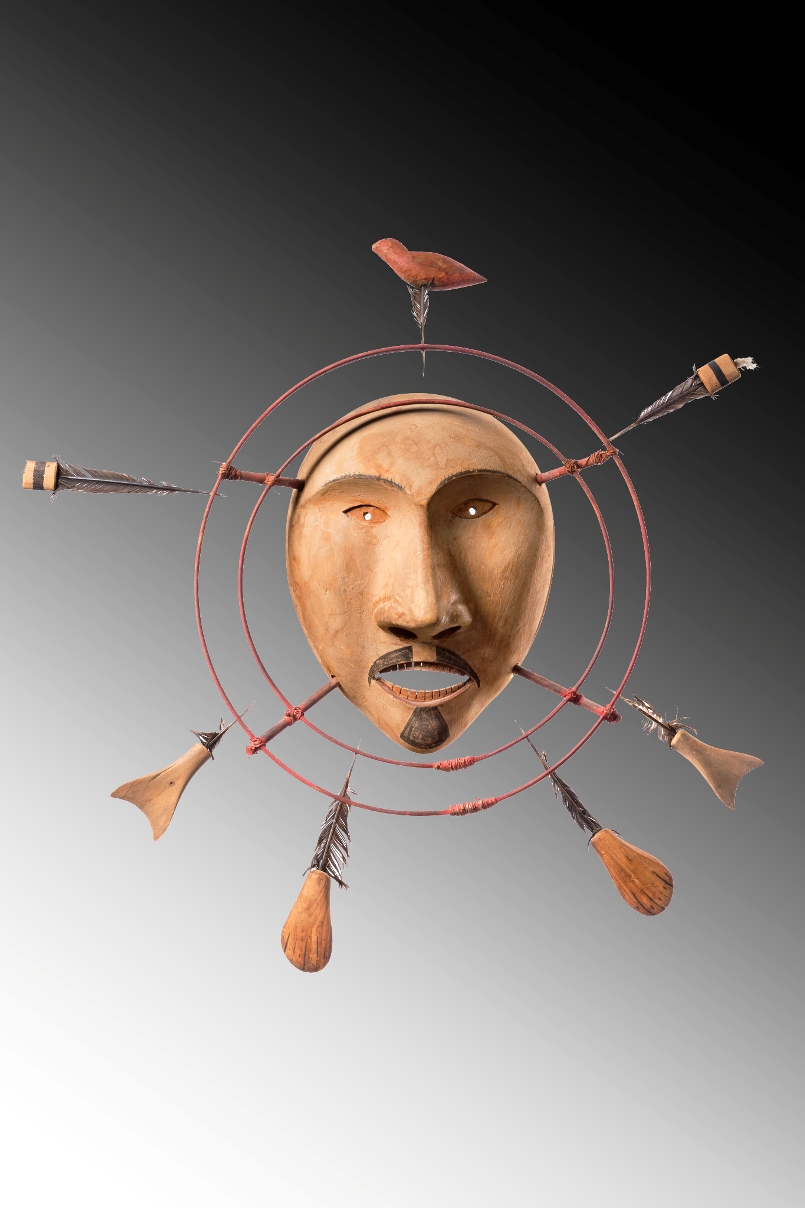
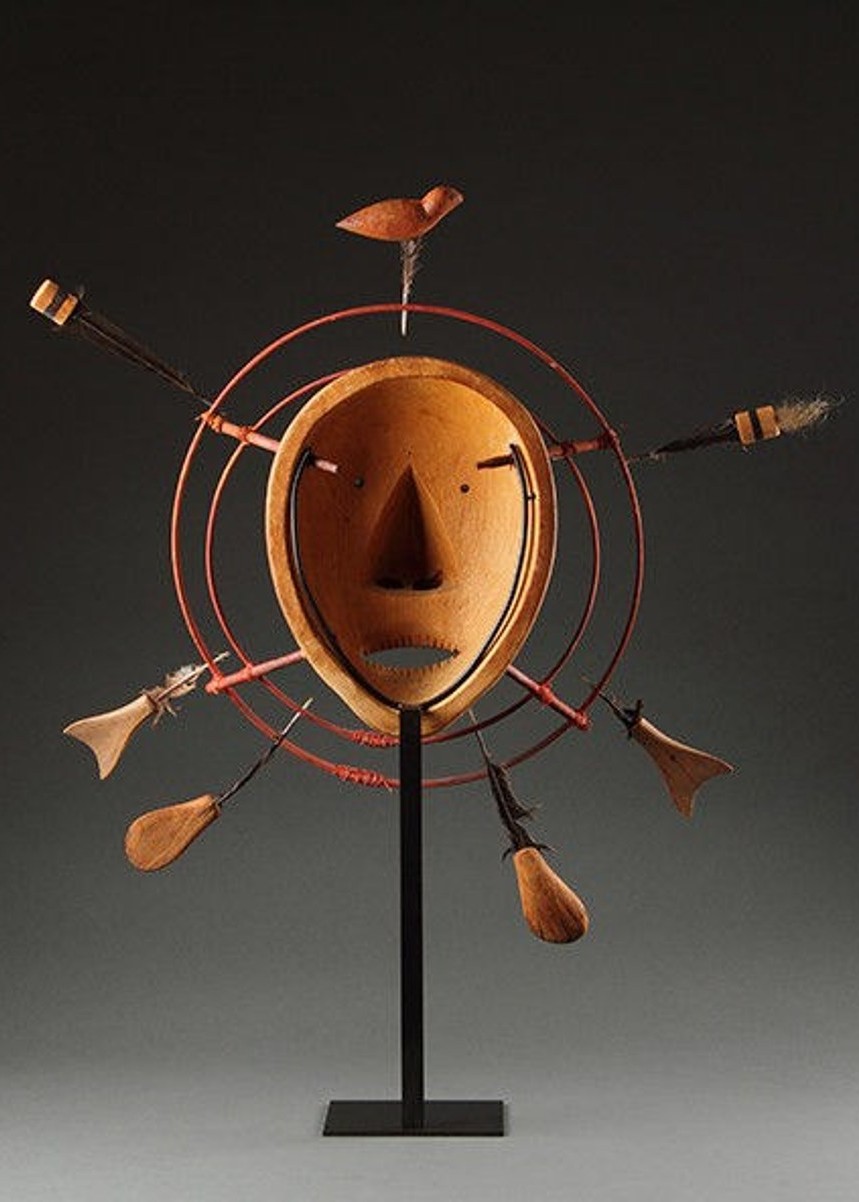
This mask features a complex structure centered on a human face.
It is surrounded by a double circle known as ellanguat2, around which numerous figurative elements (seal and its fins, two whale tails and geometric shapes) revolve.
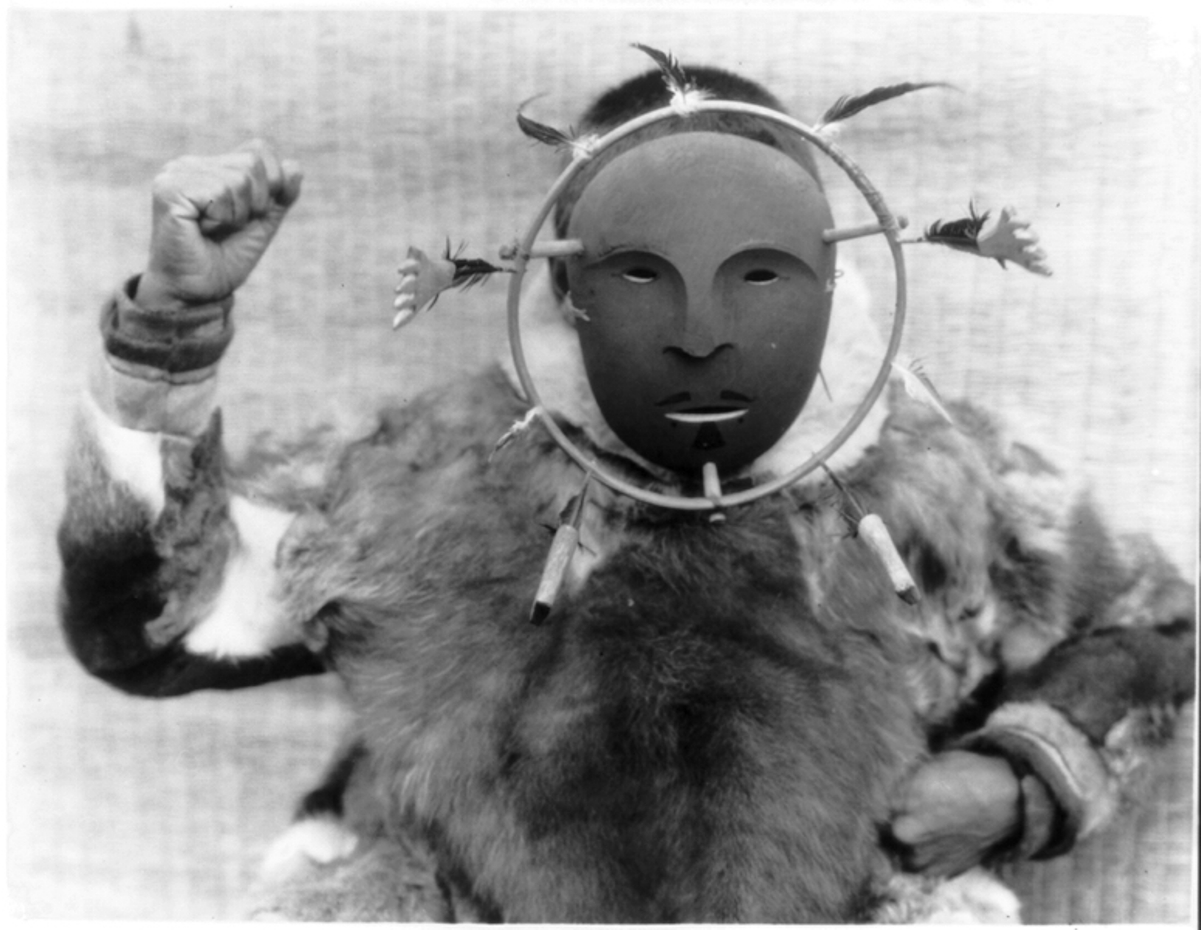
Much admired and collected by artists such as Georges Braque or Henri Matisse and members of the Surrealist movement, this mask was worn by the shaman to facilitate communication and travel between worlds (the visible and the invisible, men and spirits, the living and the dead…).
The pure form and subtle, detailed surface modeling of this magnificent mask are characteristic of the mask-making tradition of Nunivak Island in the Bering Strait.
Tununak is a village located in the northeast of Nelson Island, Alaska. Given its proximity to Nunivak Island, it’s likely that this mask was made there and then moved to Nelson Island.
According to Ann Fienup-Riordan3, in Yup’ik tradition,this type of mask represents a salmon that has jumped out of the water and fallen to the shore, taking on the form of a living person.
1- Feathers from birds of the Corvidae family of the Common Raven species(Corvux corax). Species not regulated under the Washington Convention (CITES) and European Community Regulation E 338/97 of December 9, 1996 and the French Environment Code.
2- Ellanguat are large wooden hoops set with feathers, used in certain ceremonies to signify the superimposed worlds that make up the Yup’ik universe. The concentric circles surrounding the masks have a similar significance, representing the dual world of human and animal spirits.
3- Ann Fienup-Riordan 1996. The living tradition of Yup’ik mask, your Way of making prayer. University of Washington Press Seattle & London, p.242
For further information, please contact us at
(+33)(0) 6 07 23 33 60, or leave us a message:
Galerie Franck Marcelin – 70 chemin du Moulin – 13510 Eguilles – mob: (+33)(0)6 0723 3360 – franckmarcelin@sfr.fr – copyright © 2024