
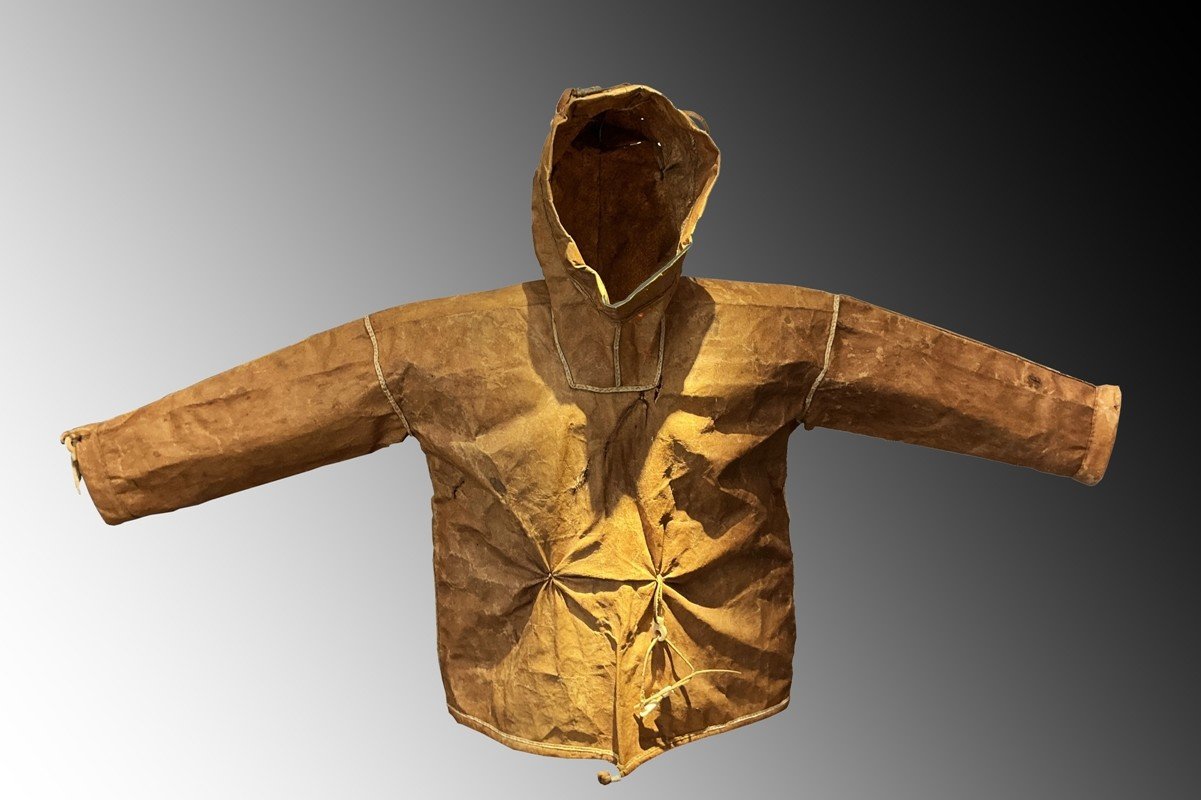
Seal skin decorated with white stripes, bones
. Dimensions: Height 63 cm
. Estimated date:First half ofthe 20th century
. Inuit group
. West Coast
. Greenland
. Provenance:
. Danish private collection.
Like many words that have entered everyday language—such as “kayak,” “igloo,” and “parka”—the word “anorak” is derived from the Inuktitut word anoré (which means “wind”).
This waterproof, hooded garment, made for a child, is constructed from strips of scraped sealskin, sewn and assembled with very tight stitches to ensure it is completely waterproof. It still has its drawstrings around the hood, cuffs, waist, and hem.
A lightweight garment, it was worn during the summer months (winter clothing, such as parkas, was trimmed with fur).
The very contemporary look of this anorak, with its simple design and flexible fabric, allowed for great freedom of movement. But it also served a ritual purpose and was worn to ward off harmful influences and attract good luck.
It was a symbol of wealth and was worn by shamans during rituals. In this animist culture, a new anorak was worn at the start of the spring seal-hunting season. Anoraks and tanned seal skins were also offered during the annual exchange ceremonies.
This rare children’s model comes from a private Danish collection belonging to people who lived on the west coast of Greenland in the 1950s. This anorak dates from the 1900s to the 1930s, as seal skin was no longer used to make this type of garment after that period.
The National Museum of Copenhagen has a very similar model in its collection (Inv. L.5003)
For further information, please contact us at
(+33)(0) 6 07 23 33 60, or leave us a message:
Galerie Franck Marcelin – 70 chemin du Moulin – 13510 Eguilles – mob: (+33)(0)6 0723 3360 – franckmarcelin@sfr.fr – copyright © 2024