
Driftwood, soot black,
ivory from a marine mammal (walrus, Odobenus rosmarus)
Dimensions: 22.5 x 13 cm
Estimated date:First half of the20th century
Inuit people
Ammassalik-Tasiilaq District
Greenland
Source:
Collected by Elias Lauf, an Inuit pastor, in the late 1930s (1)
Lars and Jytte Soelberg Collection, Copenhagen.
Publication:
Geertsen. Greenlandic mask. 1994. Reproduced from this page. 90.
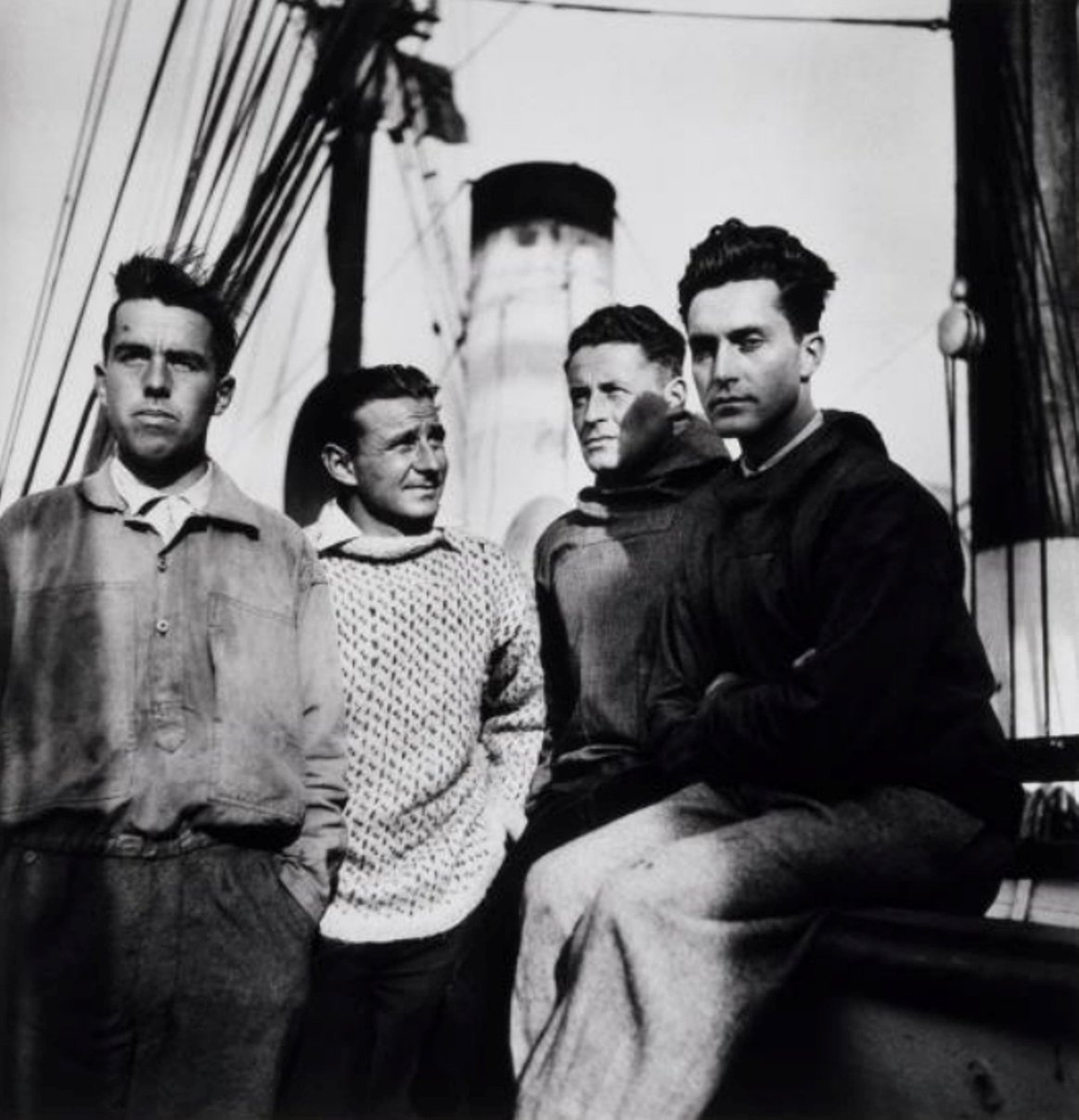
Photo from the French Greenland Expedition
. From left to right: Michel Pérez, Freddy Matter, Paul-Emile Victor, and Robert Gessain on the “Pourquoi-Pas?” Inv. No.: 2005.8.18 – © Robert Gessain (1907–1986)
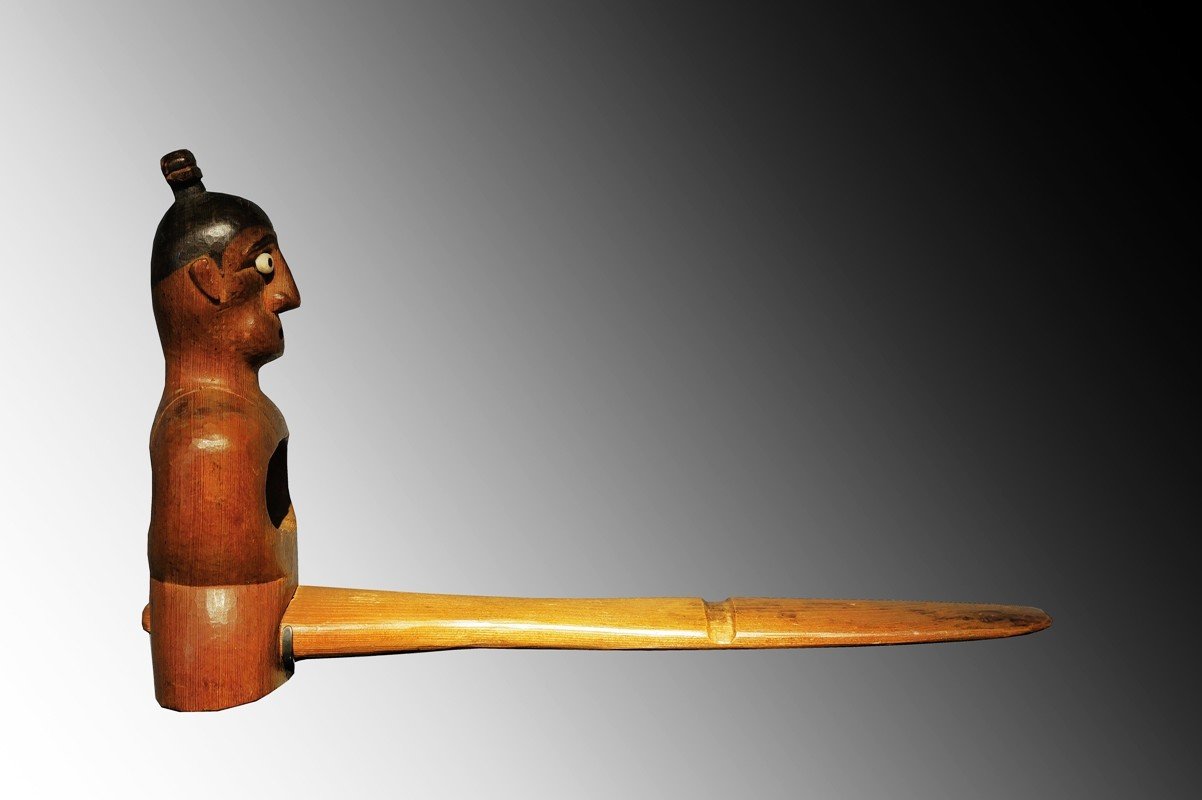
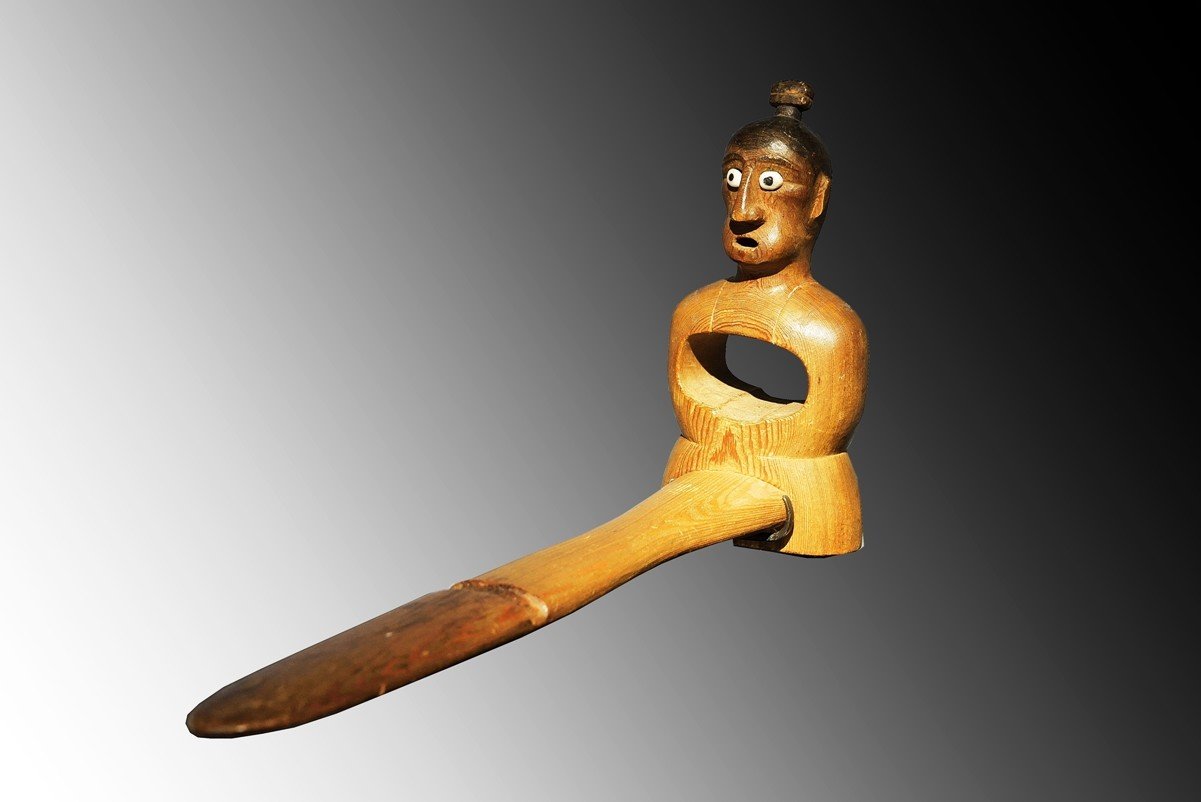
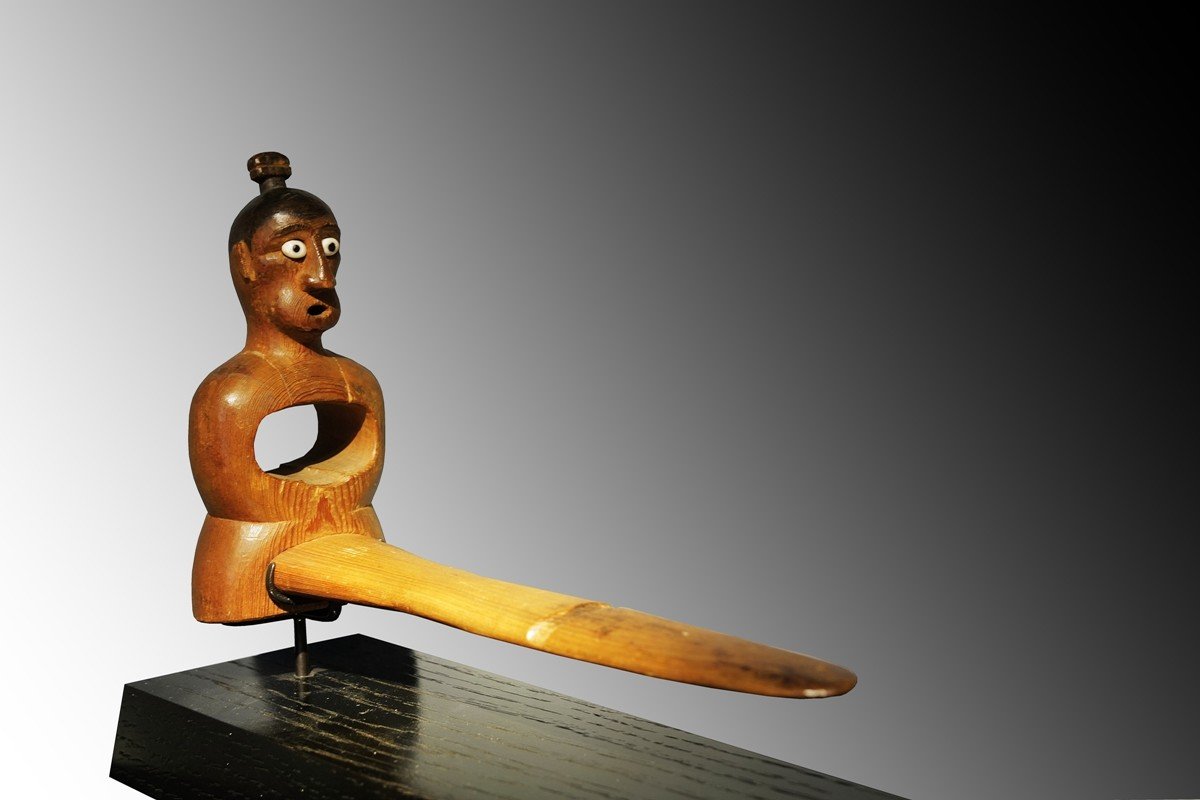
This rifle mount, known in the Ammassalik dialect as katazip iveqa (2), consists of two parts:
—the rod designed to be slipped under the frontmost cross strap of the taqâdâ kayak(3) (Fig. 1)
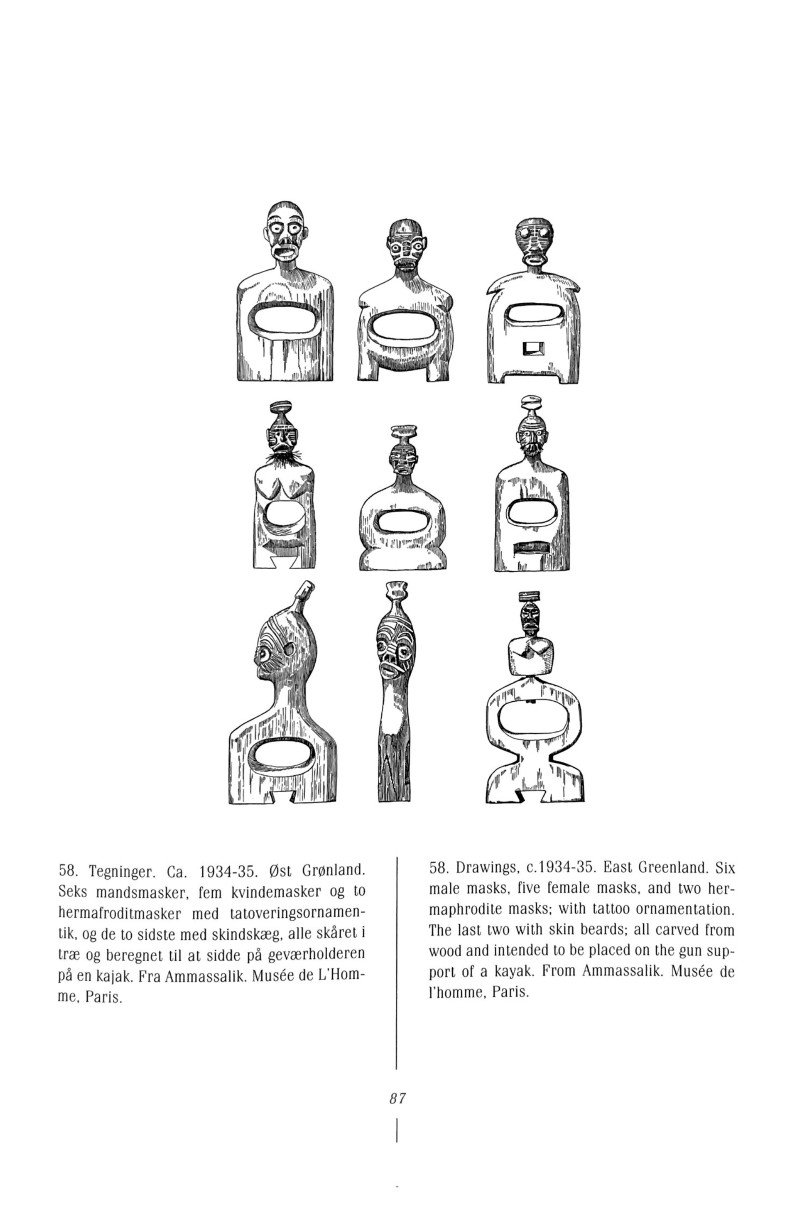
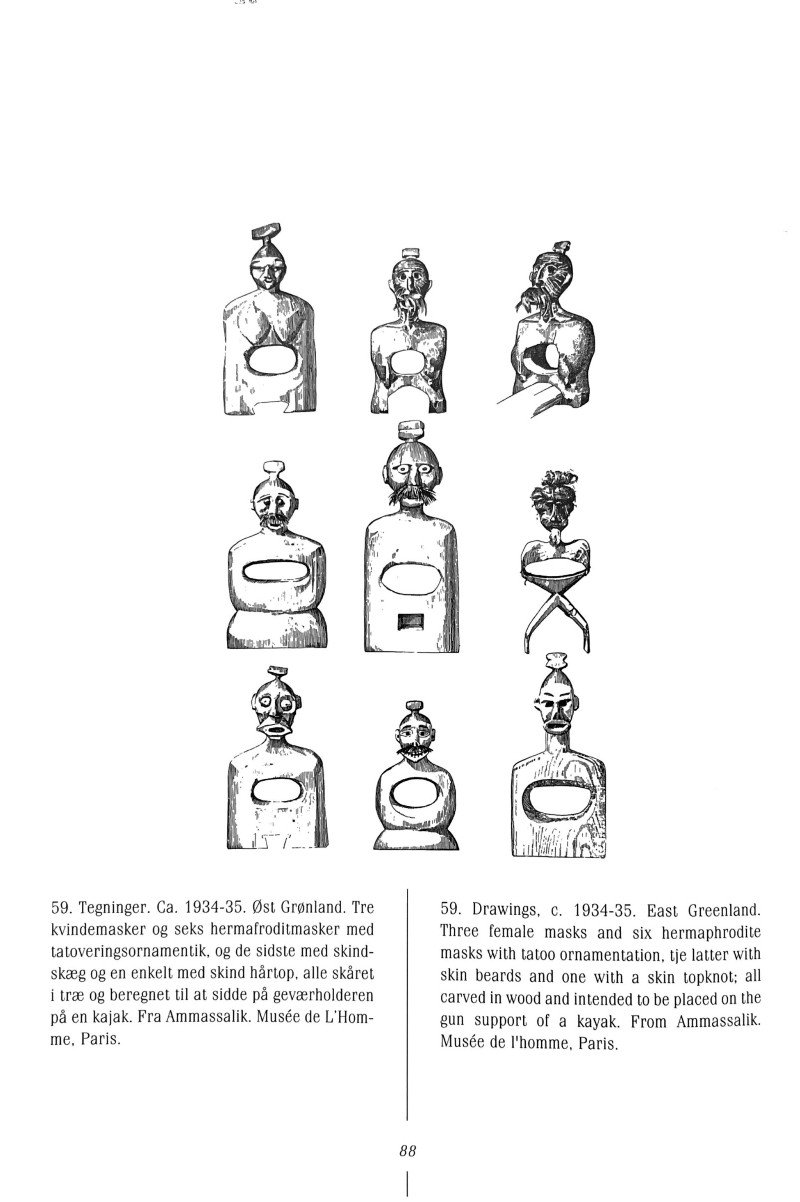
– A human figure called Uiseq ( or Uizé) (2) or Uizerq (according to Robert Gessain), depicting a female bust held in place by a rectangular tenon, recognizable by her high bun. The hair is painted black. The eyes are represented by ivory inlays.
This figure has a hole drilled through its abdomen, allowing the end of a rifle barrel to be inserted through it.
The piece was placed on the front of the kayak, in front of the white canvas camouflage screen (Fig. 2).
We have little information about this very rare rifle mount. Anthropologist Robert Gessain, a member of the French expedition to Greenland, documented the use of wooden statuettes (similar to the magical tupilak figurines) attached to the kayak to serve as physical supports for securing the weapon on the deck.
He writes about this type of medium (4), “ Our Inuit informants told us nothing about this. When we asked them questions, they responded with little more than forced smiles. We got the impression that they were embarrassed by what the pastor might think of their response. Traditional beliefs and myths were being actively discredited under Christian influence. We ran out of time to continue the investigation. Could we be dealing with a human representation that has parallels in the legends and myths of Angmassalik? Undoubtedly, since androgynous characters appear in the legends of Angmassalik. “.
He went on to say:
“A legendary figure, also androgynous, seems to us to be of even greater interest in relation to our figurines: Ukuamaq, the phallic mother, as depicted in a poem that W. Thalbitzer kindly brought to our attention (1923, p. 235) when we asked him about the meaning of the androgynous figurine on the rifle stocks.”
Here is the poem and, in summary, the explanations that W. Thalbitzer gathered from informants in Angmassalik and southern Greenland:
“My son—I took his wife away from him.”
My son—I made him childless
I have become a great hunter where the Greenland seals are lured
Right out at the hiding place farthest out at sea
The Greenland seal was stabbed there
I brought it home to the mainland “.(5)
The informants paraphrased this condensed poem, explaining that the old woman began to live like a man, hunting seals in a kayak and taking her daughter-in-law as his wife, using the front of the kayak as a penis (6) (Thalbitzer 1923, pp. 234, 511–514). Some versions add that the grandmother was an angakok (7) and that the stepdaughter was a transformed Greenland seal.”
And it concludes:
“From this legend, the elements most relevant to our topic seem to us to be the following:
– the association of masculinity with respect to the woman and the hunter’s strength with respect to the seal: the mother takes both her son’s wife and the seals, replacing her son both beside his wife and in his kayak. This could be an argument in favor of the analogy sketched out in the poem between the woman and the seal.
– The mother transforms into a man by fashioning a penis from the front of the kayak. If we accept a connection between these legends of the phallic, hunter mother and the androgynous figurine adorning the bow of the kayak and the tip of the most powerful weapon it carries, we can understand the psychological motivation of the Eskimo hunter who, in a symbolically rich act, places such a powerful figure at the bow of his kayak.
It is remarkable to note among the Eskimos of Angmassalik the presence of a new technical device that allows for the integration of a weapon as revolutionary as the rifle into their traditional kayak arsenal. It seems even more remarkable to us that this mount is adorned with a figurine that bears all the hallmarks of a traditional mythical figure.”
The Musée du Quai Branly–Jacques Chirac holds in its collections nine (8) complete rifle butts similar to ours, depicting women wearing the traditional bun. All of them come from the Musée de l’Homme and were collected during the French Greenland Expedition (1934–1935). (9)
The introduction of the rifle in the late19th century by Western traders profoundly altered the very structure of the kayak’s deck, which had originally been designed solely for the harpoon.
At first, the rifle was kept inside the kayak, which often led to accidents when the loaded weapon was removed through the hatch.
The first adaptation designed to meet functional requirements was the creation of a protective rifle case, secured in front of the hunter on the kayak deck and positioned along the kayak’s centerline.
But shooting from a traditional, very narrow kayak (often less than 50 cm wide) was extremely dangerous. The case, secured along the kayak’s centerline, prevented sudden movements and made it easier for the hunter to maneuver. With the rifle perfectly aligned and the kayak stabilized (10).
In addition to their mechanical function, these carvings had a strong spiritual significance, intended to secure the protection of the spirits for the hunter and to attract game (seals, walruses).
_______
Notes:
1- Elias Peter Niels Isak Lauf (1894–1981) grew up as the son of a hunter. At the age of 15, he was admitted to the Greenland Seminary. He graduated in 1915 and then left for Denmark to continue his theological studies. In 1918, he returned to Greenland and became a teacher and senior catechist. Then, in 1919, he became a professor at the Nuuk Seminary. In 1920, he was ordained as a pastor and settled in Paamiut a year later. In 1931, he was transferred to Upernavik, likely because his views on modernization were considered too radical. As early as the 1920s, he was convinced that Greenland should be represented in the Danish Parliament. Greenland’s first modern school was established on his initiative. In 1937, he moved to South Greenland and became a pastor in Qaqortoq, then to East Greenland, where he served in Ammassalik (the former name of Tasiilaq) until 1945.
2-katazip iveqa The first term is the genitive form of the word for “rifle.” We do not know the etymology of the second term, which could mean “support.” Giulia Bogliolo Bruna, in her book *Les objets messagers de la pensée Inuit* ( page 75), discusses the term *uiseq* ( or *uizé*) when referring to carved representations of androgynous figures with a woman’s bun and an enormous male phallus (perhaps referring to the rod located in front of the figure) among the Ammassalik Inuit. Robert Gessain, for his part, refers to it as Uizerq (Uizerq, *The Lover*, 1975). However , other pronunciations vary depending on the location or the informant.
3- The Quai Branly-Jacques Chirac Museum has reproduced the old notes from the Musée de l’Homme as follows: “A rifle barrel support consisting of two parts, one of which is designed to be threaded between the two ‘taqa’ straps to hold the second part—through which the rifle barrel is passed—and which is adorned with a human figure…. ”
However, according to Robert Gessain’s drawing (Fig. 2), the rifle mount is secured to the frontmost strap of the kayak, known as the taqâdâ.
According to Paul Emile Victor, in his book *La civilisation du phoque* (1989 edition, p. 41, fig. 35), the term “taqa” is the vernacular name given to the transverse straps located at the front and rear of the manhole.
4- Robert Gessain, “Androgynous Eskimo Figurine (Rifle Rest on a Kayak)”
Journal of the Society of Americanists. Vol. 43. 1954, p. 214.
5- “My son—I have deprived him of his wife.”
My son—I made him a widower.
I became a great hunter where the harp seals are drawn,
Far out at sea, in the most remote den.
That is where I stabbed the harp seal,
And I brought it back to the mainland.”
6- It is worth noting here the presence, at the ends of the kayak, of a bone fragment about which Thalbitzer (1923, p. 391, fig. 97) states: “it is in the shape of a mushroom, the upper part forming a hemispherical head surrounded by a groove. ” (It is shaped like a mushroom, the upper part of which forms a hemispherical head surrounded by a groove.) This euphemistic description and the accompanying illustration leave no doubt as to the phallic shape of this piece.
7-angakok, the name given to a shaman. The shaman’s ability to change gender is attested to by a large number of authors.
8- Inventory number: 7.1.1934.175.2520.1-2 / 71.1934.175.2522.1-2 / 71.1934.175.2523.1-2 / 71.1934.175.2525.1-2 / 71.1934.175.2526.1-2 / 71.1934.175.2529.1-2 / 71.1934.175.2530.1-2 / 71.1934.175.2676 / 71.1934.175.3009
A total of 26 pieces, some incomplete, others featuring male figures.
9- This first French ethnographic and scientific expedition set out aboard Commander Charcot’s *Le Pourquoi-Pas?* (
), which set sail from Saint-Malo on July 10, 1934.
On board were ethnologist and expedition leader Paul-Emile Victor, accompanied by physician and anthropologist Robert Gessain, Swiss geologist Michel Perez, and filmmaker Fred Matter-Steveniers.
On August 31, 1934, the four scientists landed in Ammassalik, a village named after capelin (ammassat), fish whose presence heralds the return of spring.A year later, Charcot returned to Greenland to bring the team and its findings back to the Trocadéro Museum of Ethnography. A large collection of photographs and a trove of nearly 4,000 objects (purchased with the team’s personal funds or bartered) were gathered, while Gessain’s genealogical and anthropological records, vocabulary lists, and audio recordings of Inuit songs round out the collection.
10—It was shortly after the introduction of the rifle imported by Europeans and its use aboard kayaks that the Inuit began attaching a keel to their boats. Although the rifle was used to kill or wound the animal from a distance, the harpoon remained indispensable. Since a dead seal quickly begins to sink, the hunter had to approach immediately to harpoon it in order to secure the carcass
Figures:
Fig. 1—Paul Emile Victor & Joëlle Robert-Lamblin, *The Civilization of the Seal*. Page 41, fig. 35.
Fig. 2—Robert Gessain, Androgynous Eskimo Figurine (rifle rest on the kayak), Journal of the Society of Americanists, Vol. 43. 1954. p. 208, fig. 22
Figs. 3 & 4—Ib Geertsen. Greenlandic mask. 1994. Figs. 58 & 59 Probably based on drawings by Robert Gessain.
Literature :
-Giulia Bogliolo Bruna, *The Objects That Convey Inuit Thought*, “Ethics of Creation” series (Charles Cros Institute/Harmattan), 2015,
-Giulia Bogliolo Bruna , “Androgynes, Arctic Venuses, and Zoo-Anthropomorphic Creatures: When Inuit Shamanism Becomes an Object,” Charles Cros Institute
-Ib Geertsen, *Gronlandske Masker / Greenlandic Masks. Rhodos. International Science and Art Publishers. 1981
-Robert Gessain, Inuit. Images from Ammassalik (Greenland, 1934–1936) . Foreword by Yves Coppens. Paris, La Martinière, 2007
-Robert Gessain Androgynous Inuit figurine (rifle rest on a kayak) Journal of the Society of Americanists, Vol. 43, 1954, pp. 207–217.
-Robert Gessain Uizerq, The Lover. A Character from the Mythology of the Ammassalimiut (East Coast of Greenland). Excerpt from the journal *Objets et Mondes*. Vol. XV, No. 3, Fall 1975.
-Fabrice Grognet Robert Gessain, Inuit. Images from Ammassalik. L’Homme: Review, No. 189, 2009. Published by EHESS. French Journal of Anthropology.
-W. Thalbitzer, *The Ammassalik Eskimo*. Part II. Medicine in Greenland , vol. 40, pp. 114–563. Copenhagen, 1923.
-Paul Emile Victor & Joëlle Robert-Lamblin. Seal Hunting Culture. Volume 1. Games, Gestures, and Techniques of the Ammassalik Inuit. Published by Armand Colin-Raymond Chabaud, 1989
For further information, please contact us at
(+33)(0) 6 07 23 33 60, or leave us a message:
Galerie Franck Marcelin – 70 chemin du Moulin – 13510 Eguilles – mob: (+33)(0)6 0723 3360 – franckmarcelin@sfr.fr – copyright © 2024