
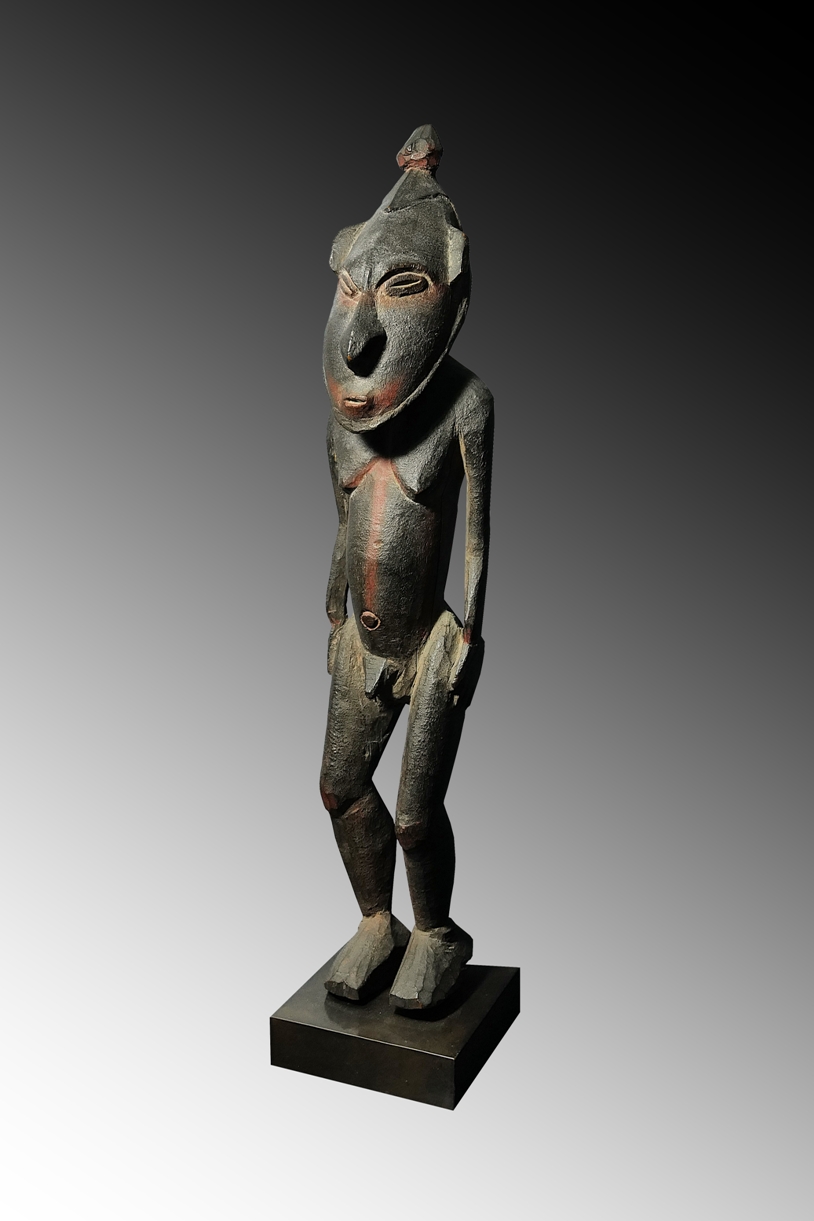
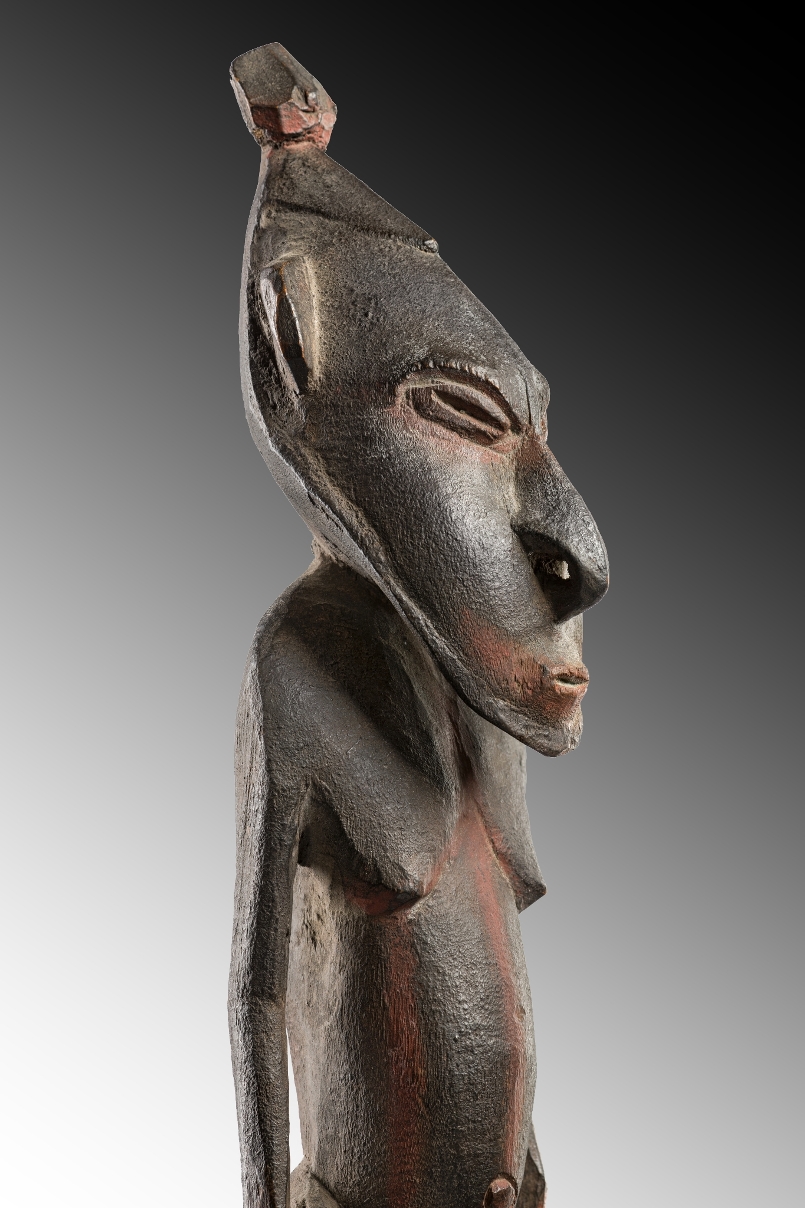
Kandimbong statuette
Wood, ochre pigment
Dimensions: Height 46cm
Presumed date of origin: 19th century
Mouth of the Sepik River
Province of Sepik Oriental
Papua New Guinea
Provenance:
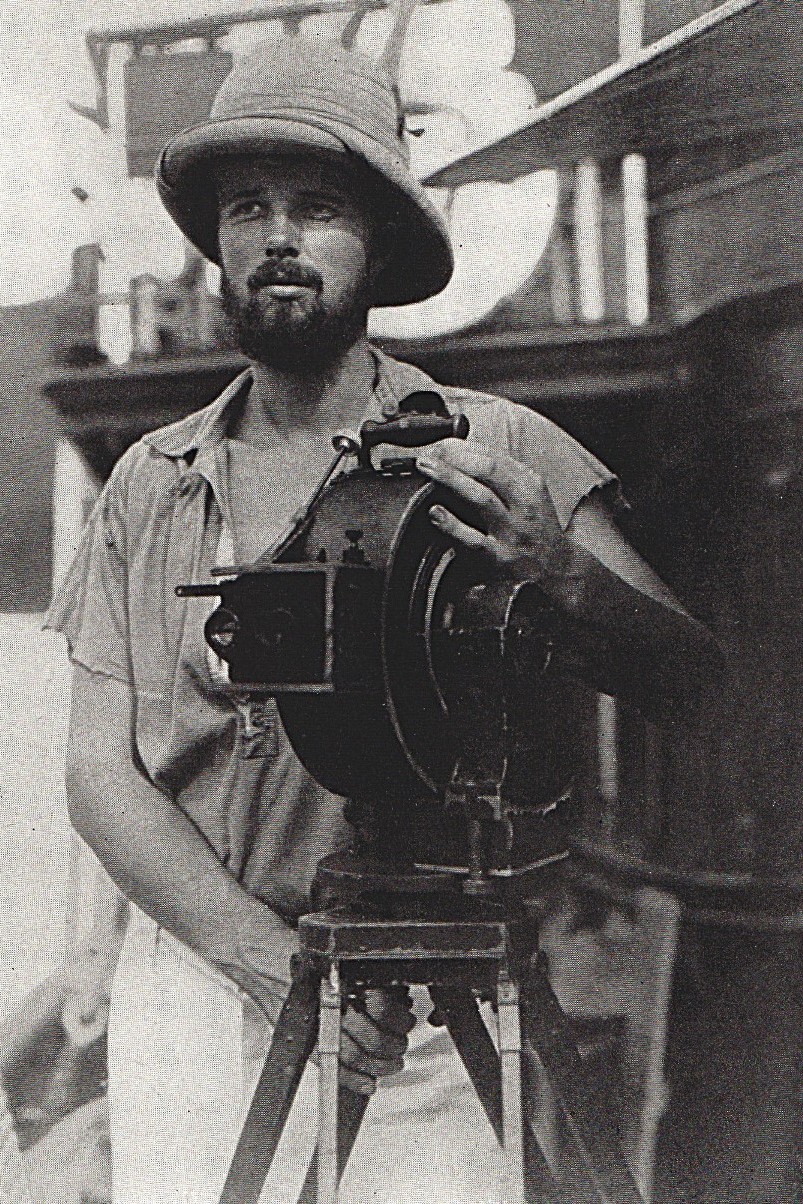
Collected by Sidney Nichols Shurcliff (1906-1981) during the Crane Pacific Expedition1928-1929.
By descent kept in the family
Bonhams Chelsea sale, May 7, 1992, lot no. 102
Alexander Kubetz Collection, Munich
The Crane Pacific Expedition
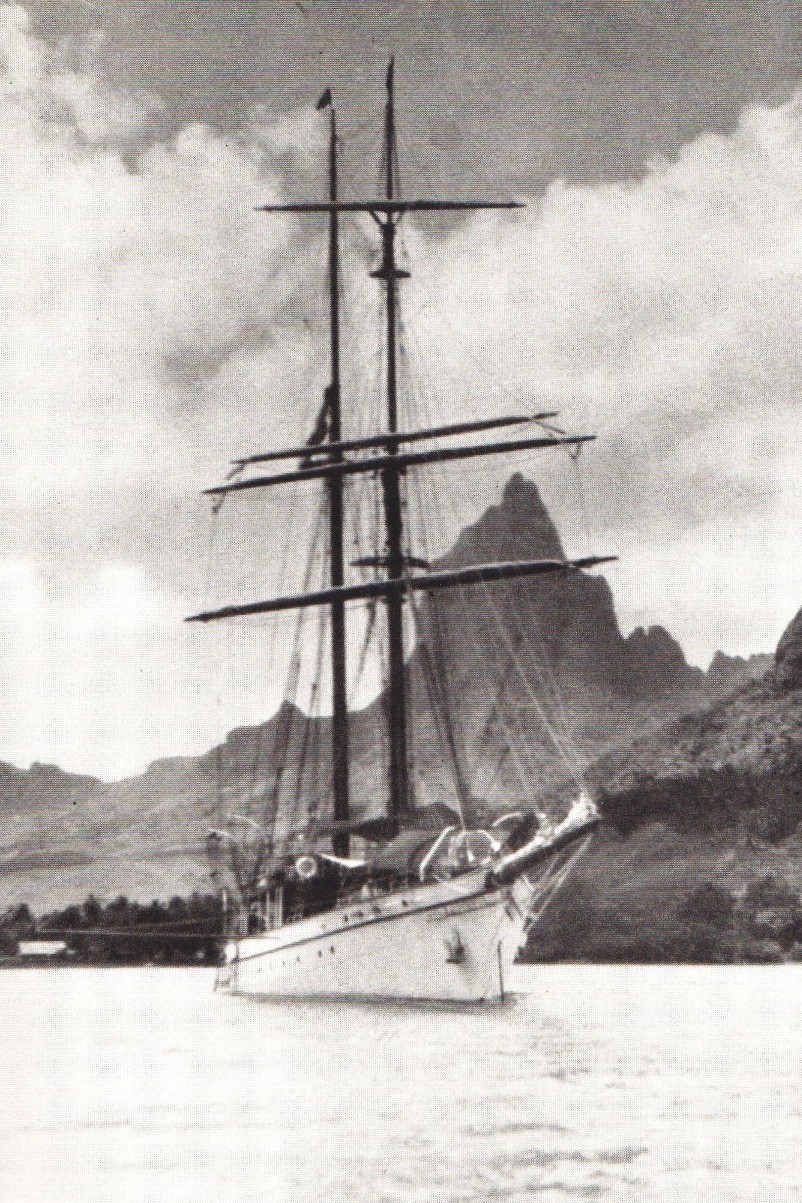
In 1927, having just graduated from Harvard University, twenty-two-year-old Cornelius Crane (1905 -1962) received a yacht from his father as a graduation present. It’s a pretty extravagant gift by today’s standards, but in the second decade of this century, before the great stock market crash, it was even more staggering. The family’s wealth was such that, it is said, the crash of 1929 had little effect on their lifestyle. The two institutional affiliations with Harvard and the Field Museum in Chicago brought Cornelius not only prestige and academic resources, but also inspiration for the use of his soon-to-be-built yacht.
Rather than take his friends on the round-the-world cruise he had originally planned, Cornelius decides to investigate the possibility of sponsoring a scientific expedition for the Field Museum in Chicago, where, due to his father’s position as trustee and benefactor, he has access to the scientific staff.
In addition to several scientists from the Boston Museum (a doctor, a zoologist, a herpetologist (in charge of reptiles), an ichthyologist(fish specialist), an ornithologist…), Cornelius will be accompanied by his fellow Harvard graduates: Murry N. Fairbank, Charles R. Peavy and Sidney Nichols Shurcliff. Cornelius will be accompanied by his Harvard-educated companions: Murry N. Fairbank, Charles R. Peavy and Sidney Nichols Shurcliff; these three will be in charge of photography and film.)
After Cuba, Haiti, Panama, the Galapagos Islands, the Marquesas, Moorea, Tahiti, the Society Islands, Fiji, the New Hebrides and the Solomons, a trip that was more or less colorful and exciting from the point of view of collecting natural species, they arrived in Rabaul, New Britain, in May 1929.
The governor then advised Cornelius Crane to enlist the services of Father Kirschbaum from the Divine Word Society mission in Marienberg, in order to carry out their “Sepik” expedition.
He is an important figure in the history of collecting and expeditions to German New Guinea. After some discussion, Kirschbaum agreed to guide the expedition upriver in exchange for three tons of provisions and the transport of fifteen people from the region to Marienberg.
Kirschbaum played a key role in the success of the Crane Pacific expedition. He had language skills and knew the location of the villages.
On May 9, 1929, theIllyria set sail up the Sepik. On May 11, at Father Kirschbaum’s suggestion, the expedition headed for Murik Lagoon, northwest of the Sepik. Father Kirschbaum had already visited the villages in this region with other missionaries.
He suggested visiting a remote village (Darapap) where “very primitive individuals” were still to be found. Sidney Shurcliff, in his book1 Jungle Islands, nevertheless highlights the interest of the men’s house they visited: impressive feather headdresses had just been made for an upcoming dance.
The team arrives in Ambot on May 12 (Kambot on the Keram) and is amazed by this new village. They discovered some fifty houses, including four gigantic ceremonial houses. Obtaining permission to enter one of them, Shurcliff and his companion Schmidt (the on-board herpetologist) see some forty young men sitting in the dark. The posts are all carved; in a “trophy room”, they catch a glimpse of a dozen shields, some 25 painted anthropomorphic wooden sculptures.
On May 14, they returned to the Sepik River after Murik, passed Marienberg again and entered the middle part of the river.
The first Iatmul village they visit is Tambanum. After Tambanum, the expedition continues up the Sepik. The same day, May 14, they visit the village of Timbunke. They stop at the village of Kanganaman on May 15. The expedition reached the village of Malu around noon on May 16, 1929. On May 18, the expedition passed Ambunti and approached the villages of Wogamush and Kubka. Navigating on German charts, Illyria finally reached the May River on May 19.
After some navigational difficulties, joining the Sepik, Illyria reached Tambanum on May 15. On May 17, a little further upstream on the Sepik, Schurcliff discovered an imposing ceremonial house in Angerman, with four openings in the gable on which human skulls had been placed. The following day, they reached Ambunti: “the outpost of white man’s civilization in the Sepik”.
The water level was high, and they hoped to be able to sail up the Sepik for another hundred miles or so… On May 20, Illyria arrived at Wogumash, near the junction with the April River.
Once past the junction with the Wogamush River, the Illirya’ s crew set off in search of a village called Kubka. That same evening, the Illyria reached the junction of the May River and the Sepik. Schurcliff notes: “By traveling 400 miles from the mouth of the Sepik, we have gone back 40,000 years in human civilization”. The next day, it’s the May River expedition by canoe…
Satisfied with having visited an “unknown” place that no one had seen for at least seventeen years, Crane and his men returned to the Marienberg mission on the evening of May 26, the expedition descending the Keram River to the villages of Kambot, Korogopa and Geketen. The expedition members are tired but delighted with their experience. Each of them has made photographs or films, or collected objects or specimens. The last “official” leg of the expedition was up the Sepik River in New Guinea.
The return
The expedition circumnavigated the globe from November 1928 to October 1929, collecting over 18,000 specimens of all kinds for the Field Museum’s various departments. Sculptures were also collected and donated to several museums. Some were kept by members of the expedition.
However, the Crane expedition is particularly important for its photographs of the Sepik River.
Today, the expedition’s collections are scattered across the United States. The sculpture collections collected by Crane, Moss, Peavy and Shurcliff are mainly housed at the Peabody Museum of Archaeology and Ethnology, Harvard University. A few objects can be found at the Field Museum and the Metropolitan Museum of Art. The 18,000 natural history specimens collected by Schmidt, Herre, Fairbank, Wonder and Weber are at the Field Museum. The four volumes of Shurcliff’s diary have been deposited at the Peabody Essex Museum in Salem, Massachusetts, along with copies of his photographs and films. Shurcliff donated contact prints of his photographs and a complete copy of the film Jungle Islands to the Metropolitan Museum of Art in 1973.
Fairbank’s negatives were also donated by Shurcliff to the Metropolitan Museum of Art at the same time. Schmidt’s photographs, specimen notes and expedition correspondence are in the Field Museum. The sculptures he collected are now in the Peabody Essex Museum. The Metropolitan Museum of Art also owns a set of copies obtained from the Moss family. The extraordinary photographic archives gathered by Crane, Shurcliff, Schmidt, Moss, Peavy and Fairbank (over 500 images from New Guinea alone) are in the form of contact sheets held by the Metropolitan Museum, the Peabody Museum, the Field Museum and the Peabody Essex Museum.
———————————————————————
1- Shurcliff, Sidney N. 1930 Jungle Islands: the “Illyria” in the South Seas…
New York and London: G. P. Putnam’s Sons.
Shurcliff, Sidney N.1979a Jungle Islands: The Illyria in the South Seas. Part 1.
Field Museum of Natural History Bulletin 50, no. 7 (July / August): 16 -26.
Shurcliff, Sidney N.1979b Jungle Islands: The Illyria in the South Seas. Part 2.
Field Museum of Natural History Bulletin 50, no. 8 (September): 16 -24.
For a study of the expedition, see :
Virginia-Lee Webb. Pacific Studies, Vol. 20, No. 4 -December 1997
Official/Unofficial images: Photographs from the Crane Pacific Expedition, 1928-1929
Metropolitan Museum of Art.
Alexander Kubetz, Munich (1946-2023)
Alexander Kubetz’s enthusiasm for art and the beginnings of his collection are to be found in Papua New Guinea and the South Sea Islands. He only came to African art, masks and figures, particularly artistic shields and handguns, many years later through his long-standing friendship with Manfred A. Zirngibl.
Pieces from his collection have been featured in exhibitions such as “Erde und Erz – 2500 Jahre afrikanische Kunst aus Terrakotta und Metall” (“Earth and Ore – 2500 Years of African Art in Terracotta and Metal”) (1998) and several times at the Haus der Völker in Schwaz/Tirol (1996, 2006, 2007 and 2009).
For further information, please contact us at
(+33)(0) 6 07 23 33 60, or leave us a message:
Galerie Franck Marcelin – 70 chemin du Moulin – 13510 Eguilles – mob: (+33)(0)6 0723 3360 – franckmarcelin@sfr.fr – copyright © 2024