
Wood (pine or birch), blue-green and red paint
Dimensions: 25 x 10 cm
Estimated date:first half of the18th century
Telemark County or the Setesdal
district in Aust-Agder County
Norway
Provenance:
German private collection
Andrey Tischenko Collection, Helsinki, Finland
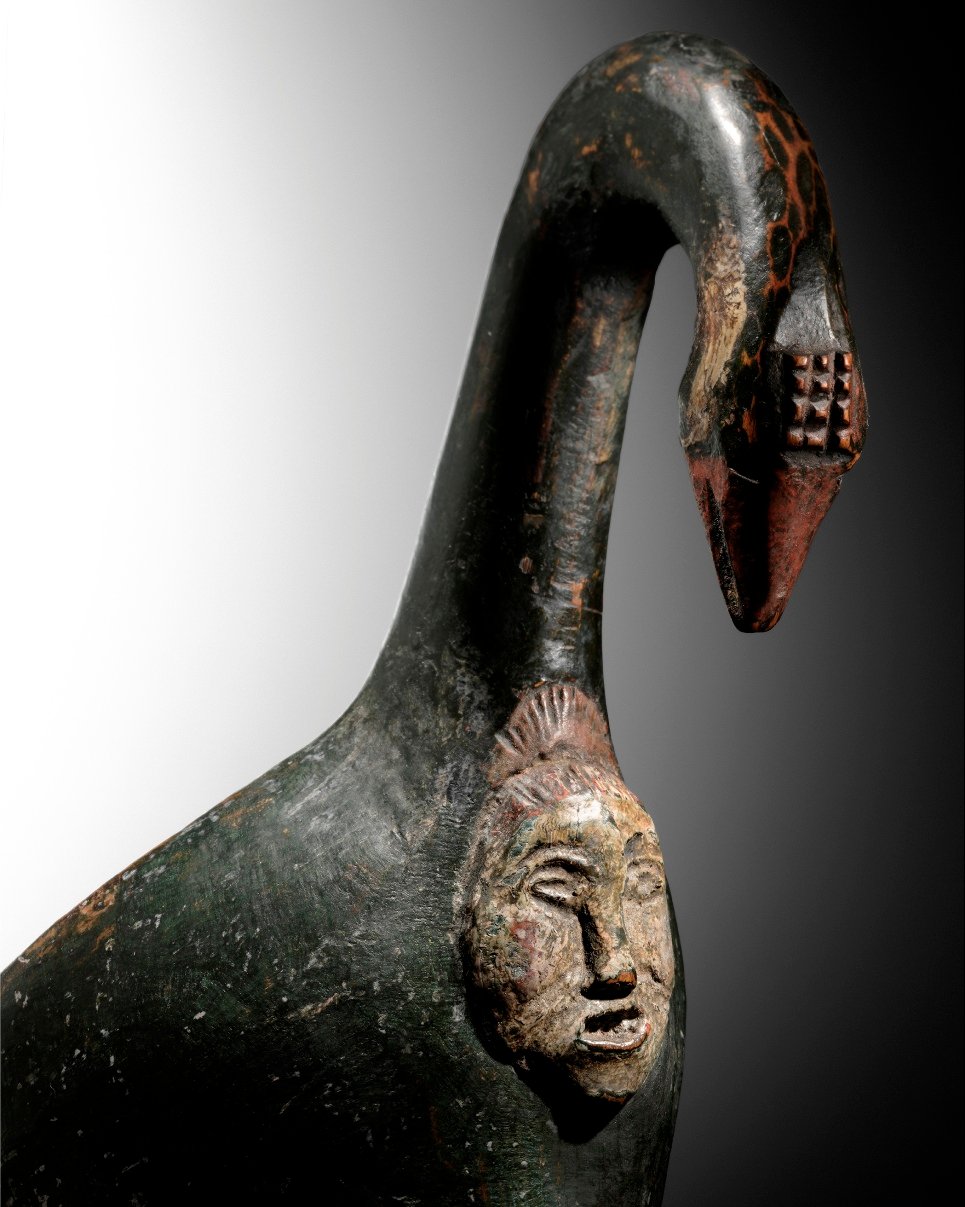
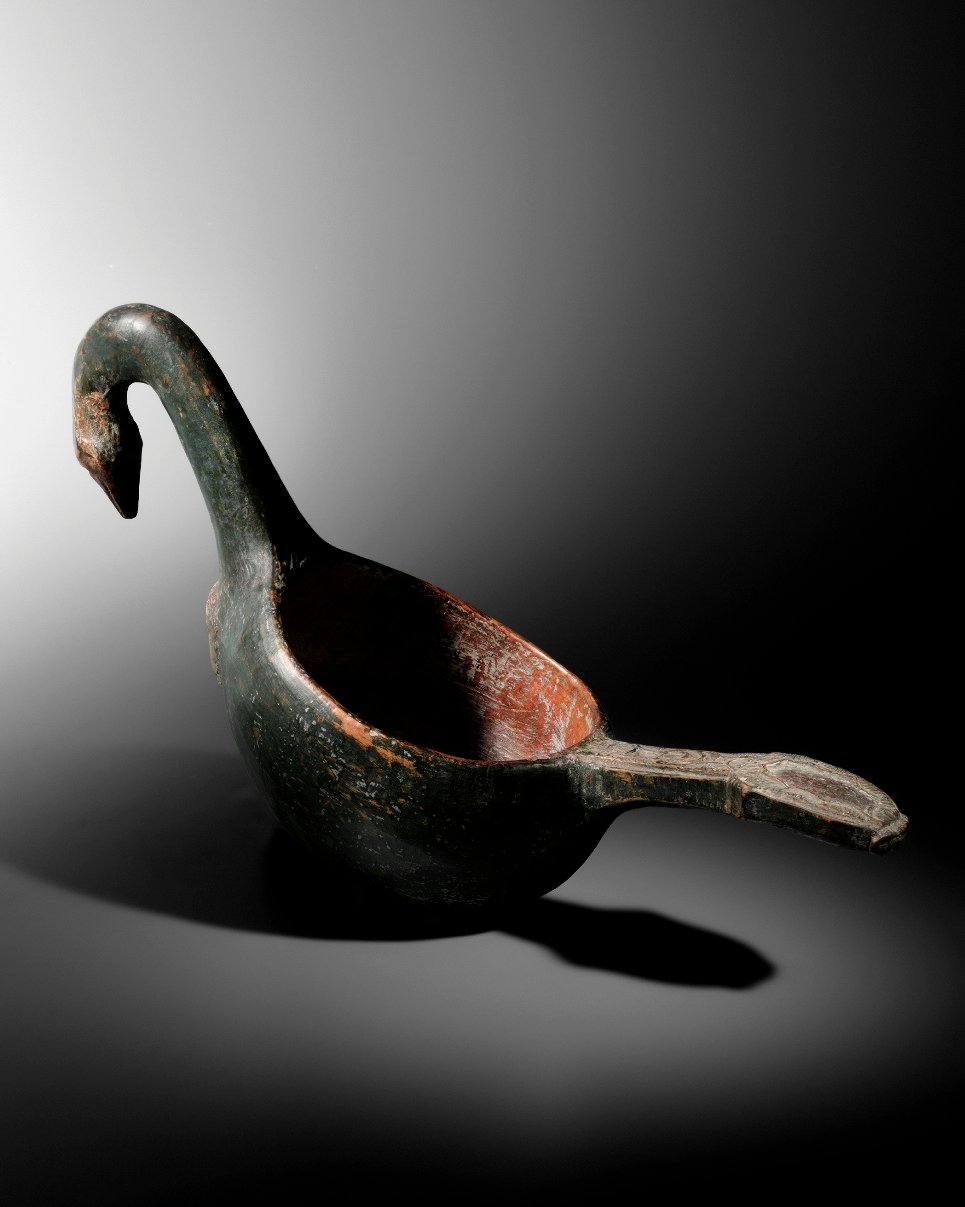
This superb Ølfugl (Norwegian for “beer bird”) was carved in the shape of a goose. The animal’s head is tilted downward, looking toward a grotesque face. The bird’s body forms the bowl. The decorated tail serves as the handle. The exterior is painted blue-green. The bird’s beak is red. There are traces of red paint inside the bowl.
This type of bowl is typical of the Telemark and Aust-Adger regions in southern Norway. It was often carved from a kåte (a knot or protrusion on a tree).
The use of farmhouse beer and wooden containers is deeply rooted in Scandinavian culture.
As far back as the Viking Age and the Middle Ages, beer was drunk in groups during special occasions (weddings, celebrations). The bowls from those ancient times were made of rough-hewn wood, carved or turned, with no painted decorations—only simple geometric engravings.¹
These bowls would sometimes float on the surface of a large communal beer vat, serving as ladles. They were used as ritual objects and were true symbols of prestige in rural areas of Norway.
According to information kindly provided by Mariken Eek (2), curator of the Telemark Museum, and Torgeir Kjos (3), curator of the Norsk Folkemuseum in Oslo, this is the only known example of this type of bowl featuring a grotesque face on the bird’s breast.
This motif was very common in Norwegian folk art as early as the Viking Age (4). In popular parlance, it is often called a “glibb,” referring to a decorative element in the form of a mask characterized by a frightening or grotesque appearance. The glibb typically featured large, bulging eyes, a flat nose, and a wide, gaping mouth with sharp teeth.
According to Norwegian folklore, these masks served as talismans (possessing magical powers intended to ward off misfortune and drive away evil spirits).
They are traditionally carved on the front of wooden sleds (spisslede), as well as at the tops of posts and on church gates.
This beer mug’s unique features make it an exceptional collector’s item.
______________
1- It was after 1750 and up until about 1870 that floral motifs—such as the Telemark rose—began to appear on both the exterior and interior of the bowls, along with inscriptions in an ancient dialect and signatures that were often rudimentary.
This painting technique is known as rosemåling, a traditional form of decorative folk art that originated in Norway.
2- Dear Franck Marcelin,
Wow! What an amazing beer mug you’ve found—truly one of a kind, with a human head on the bird’s chest! I’ve seen some with a head on the tail, but never this type. The “ale duck” is typical of Telemark and Agder, in southern Norway, and most of them—like the shape of your bird—date from the 18th century. As with most folk art in Norway, there are few artists who are actually known by name, especially when it comes to this type of tableware. But I guess you already know all this! I’m sorry I can’t be more specific. Perhaps the Norsk Folkemuseum might be able to help you further…
I’m sorry I couldn’t be of much help to you, but what a treasure you have! And I’m glad I got to see it—thank you.
Best regards,
Mariken Eek
Telemark Museum
3- Dear Franck Marcelin
Thank you for your inquiry. This “ale bird” is most likely Norwegian, possibly from Telemark or Setesdal, as such vessels were most common there and, to some extent, in Sør-Trøndelag. Given its long neck, it could be a goose, and given its sparse ornamentation, it might well date to the first half of the 1700s.
I don’t find the model all that unusual; its most unusual feature, of course, is the white mask on the front. I’ve never seen this motif on an ale bird before, though it’s widely used in Norwegian folk art from that period. In common parlance, it’s often called a “glibb.”
Best regards
Torgeir Kjos
Norsk Folkemuseum
P.O. Box 720 Skøyen, 0214 Oslo
4-. Their use dates back to ancient times, and several small masks with similar features adorned the front panels of two of the sleds discovered in 1904 during excavations of the most important Viking-era burial site at Oseberg. In the 18th century, glibbs became very popular as ornaments on the fronts of Norwegian sleds
Literature:
– Per Gjærder. *Norske drikkekar av tre*. Bergen: Universitetsforlaget, 1982
– Terje Norheim. *Ølhøner: The Gundersen Collection, Part 1* / Ad Notam Forlag, 2018
Photo © Vincent Girier Dufournier, Paris.
For further information, please contact us at
(+33)(0) 6 07 23 33 60, or leave us a message:
Galerie Franck Marcelin – 70 chemin du Moulin – 13510 Eguilles – mob: (+33)(0)6 0723 3360 – franckmarcelin@sfr.fr – copyright © 2024