
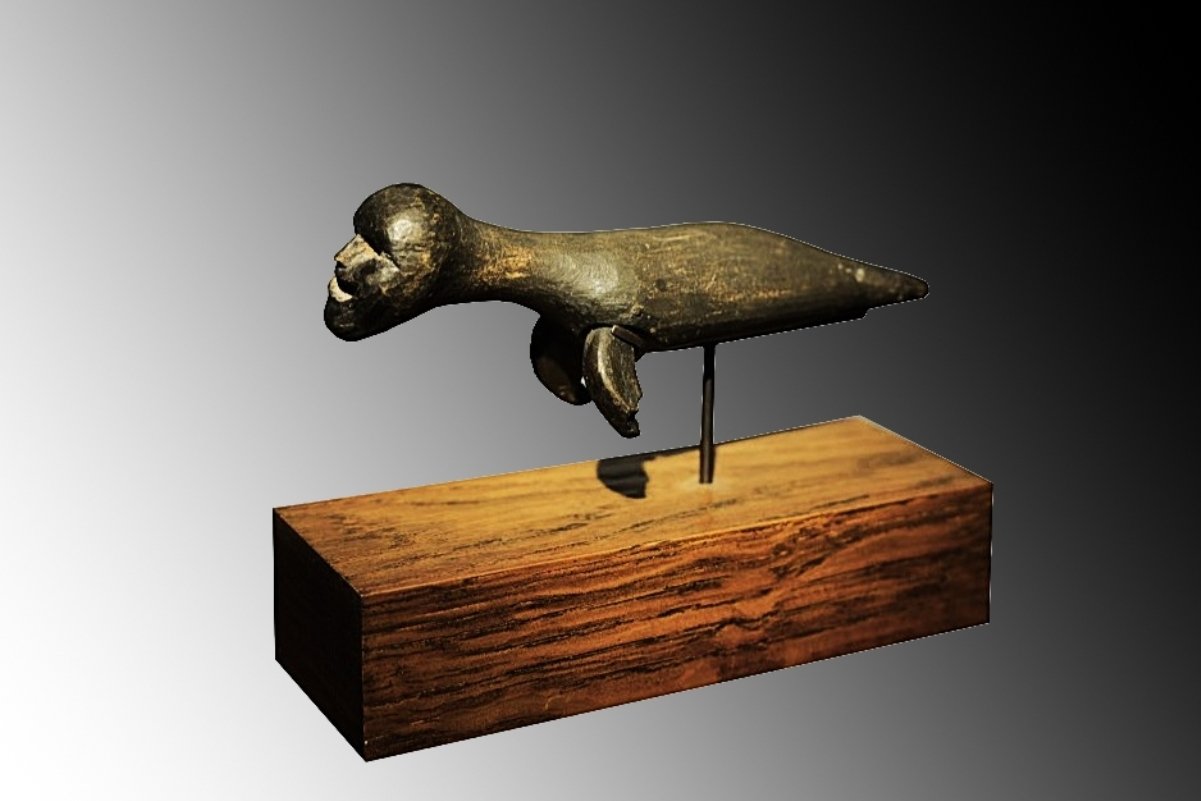
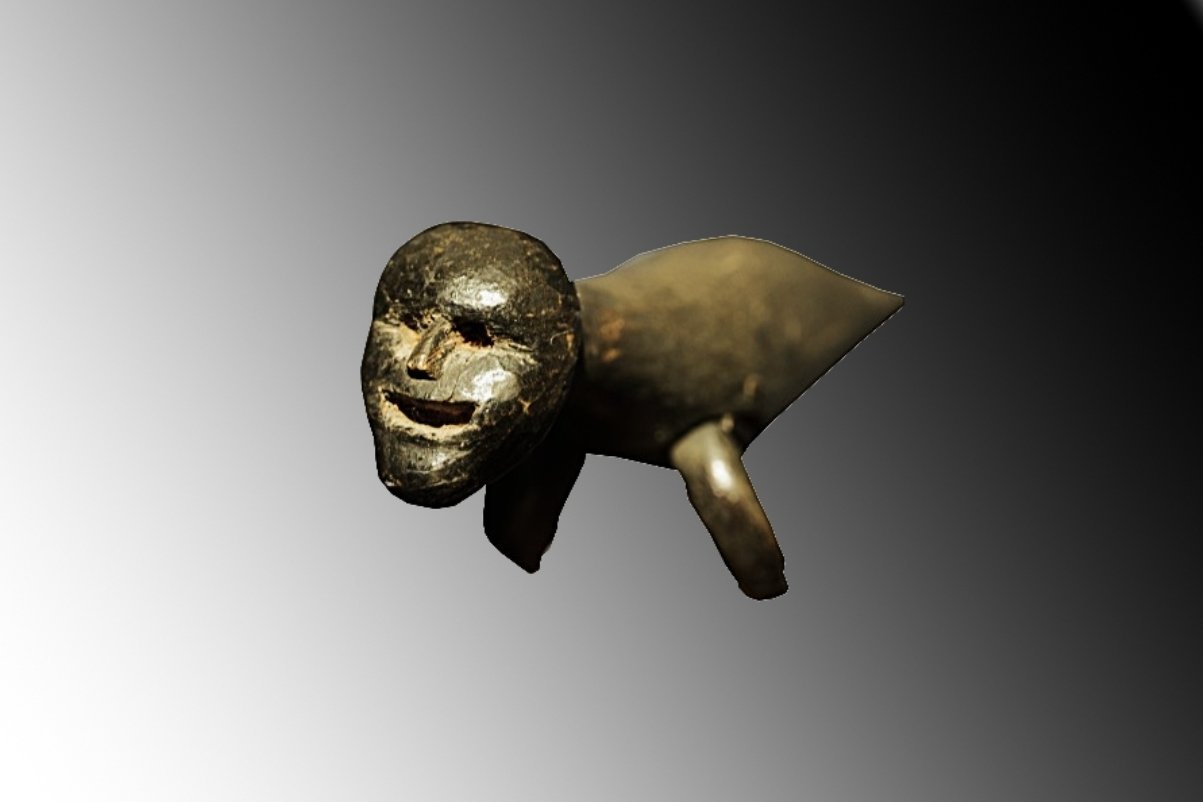
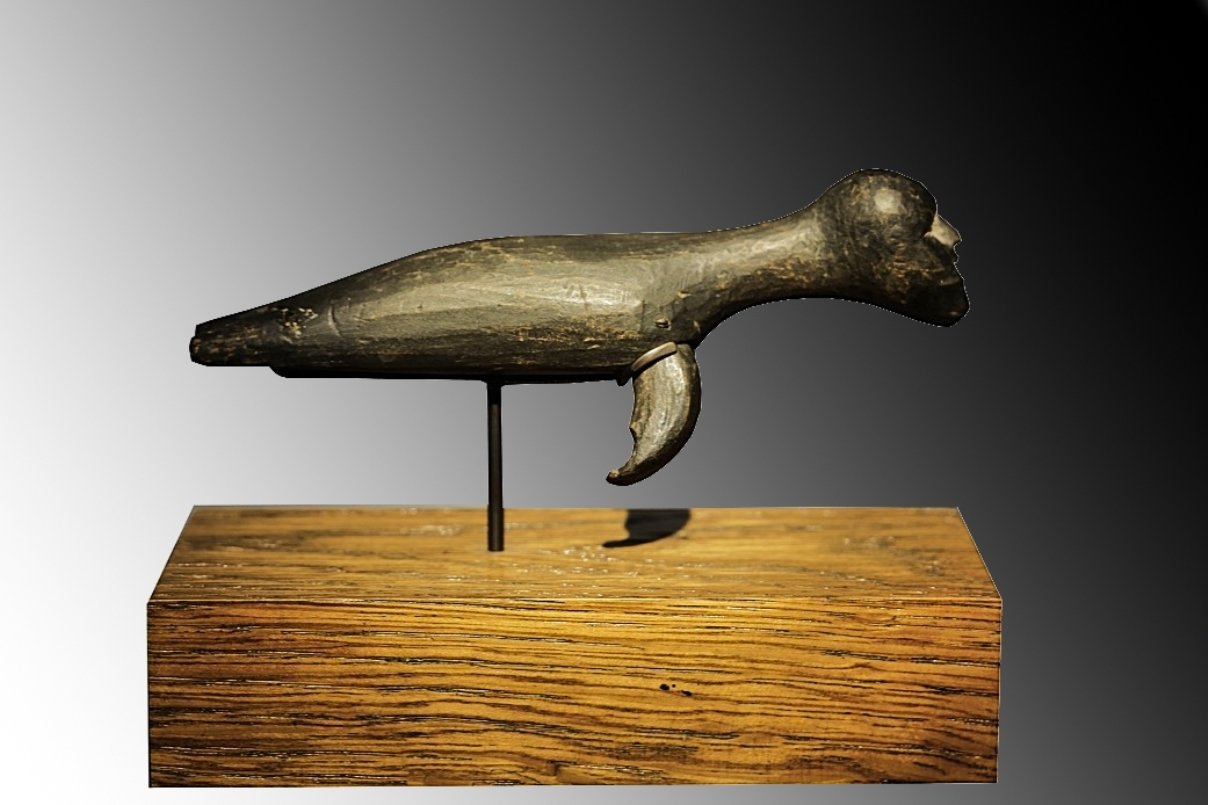
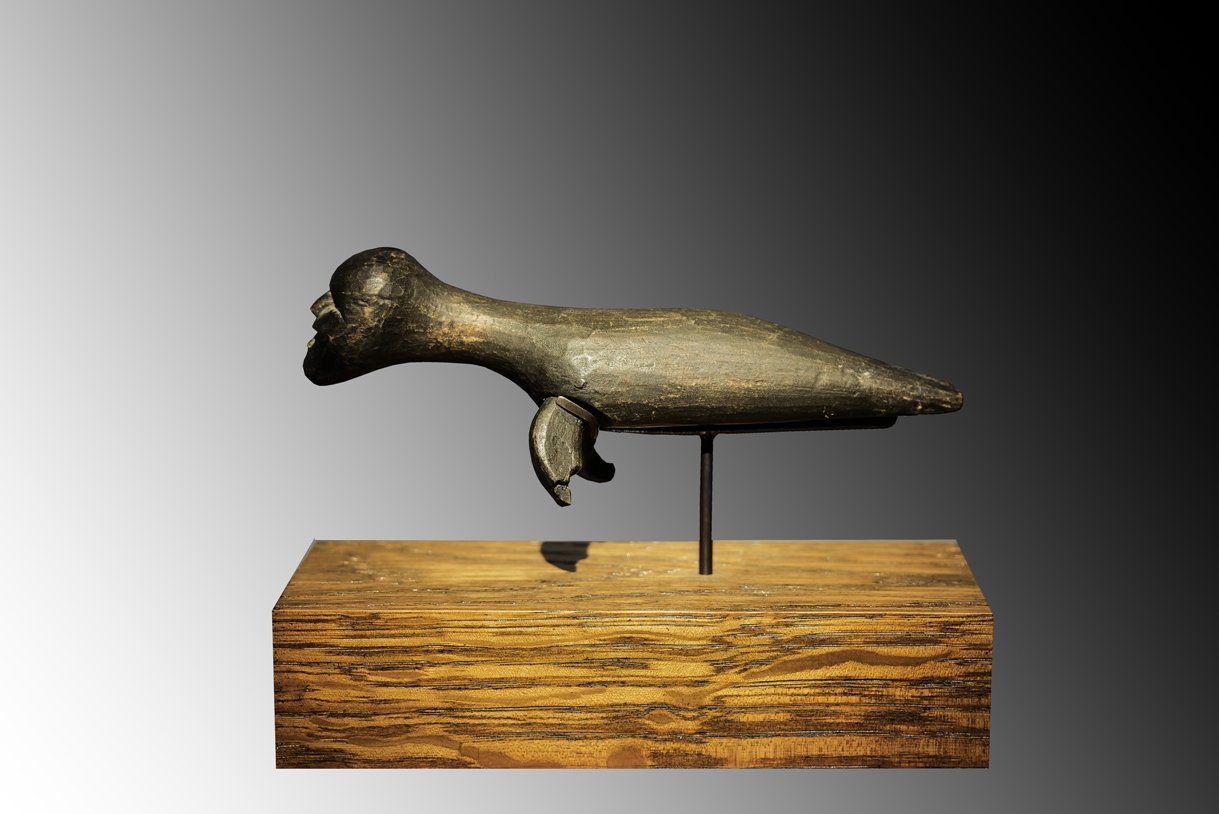
Carved wood with black pigment
Dimensions: length 14 cm
Presumed date: early20th century
Inuit people
Greenland
Provenance:
Collected by sailor Oluf Ferdinand Hansen in the late 1920s.
Preserved by the family through inheritance
Sold at Bruun Rasmussen, Denmark
David Hutzon-Frank Collection, Copenhagen, Denmark
Our Tupilak (or tupilaq), a physical and magical creature in Greenlandic Inuit mythology, is depicted as a seal with a human head.
In Greenlandic Inuit culture, the figure of the seal-man or the man-headed seal revolves primarily around two major mythological themes:
The Terrifying Tupilak and the Myth of Reincarnation and the Transformation of Souls:
Purely spiritual, invisible, and taboo, the terrifying Tupilak was secretly created by the shaman (called an angakkoq) using animal parts (bones, tendons, skin, and fur). The shaman would bring it to life by chanting ritual incantations, then cast the creature into the sea. When a shaman wanted to eliminate a rival, this man-headed seal gained the power to shapeshift. It would swim toward its victim, disguising itself as an ordinary seal to lure the victim in, before revealing its face or monstrous nature to devour it.
In Inuit mythology, the boundaries between humans and animals are blurred, because all beings possess a soul (anirniit). A famous Greenlandic folktale perfectly illustrates the concept of a seal endowed with a human consciousness:
A hunter named Navagiyaq drowns at sea. His soul, refusing to fade away, enters the body of a large female seal. While living out its life as a seal beneath the ice, the animal retains the memories, intelligence, and sensitivity of the man it once was. The soul thus travels from body to body (passing through a walrus and another seal) until the animal is hunted and its flesh brought back to the village. The soul then slips into the body of a human woman to be reborn in its original form. This legend explains the absolute respect that hunters must show toward seals, for each one may harbor the soul of an ancestor.
With the arrival of Europeans in the late19th century, the nature of the tupilak changed radically. Europeans passing through Greenland began to take an interest in these legends. To show them what these monsters looked like, Inuit carvers from the Ammassalik region began carving tupilak figurines from driftwood, bones, or walrus tusks. These carved figures served as a primary medium for telling stories and passing down Greenland’s myths and shamanic practices.
The National Museum of Denmark has a very similar model in its collection (Inv. 92903)
For further information, please contact us at
(+33)(0) 6 07 23 33 60, or leave us a message:
Galerie Franck Marcelin – 70 chemin du Moulin – 13510 Eguilles – mob: (+33)(0)6 0723 3360 – franckmarcelin@sfr.fr – copyright © 2024