
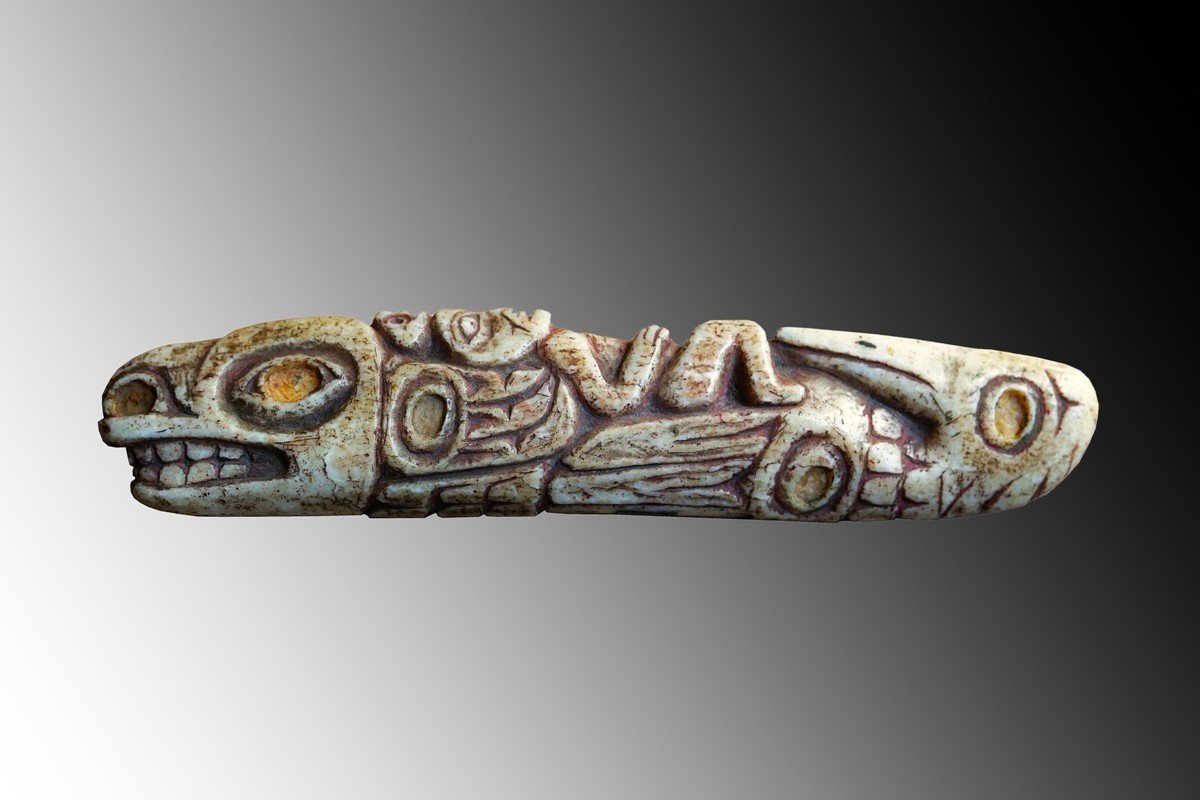
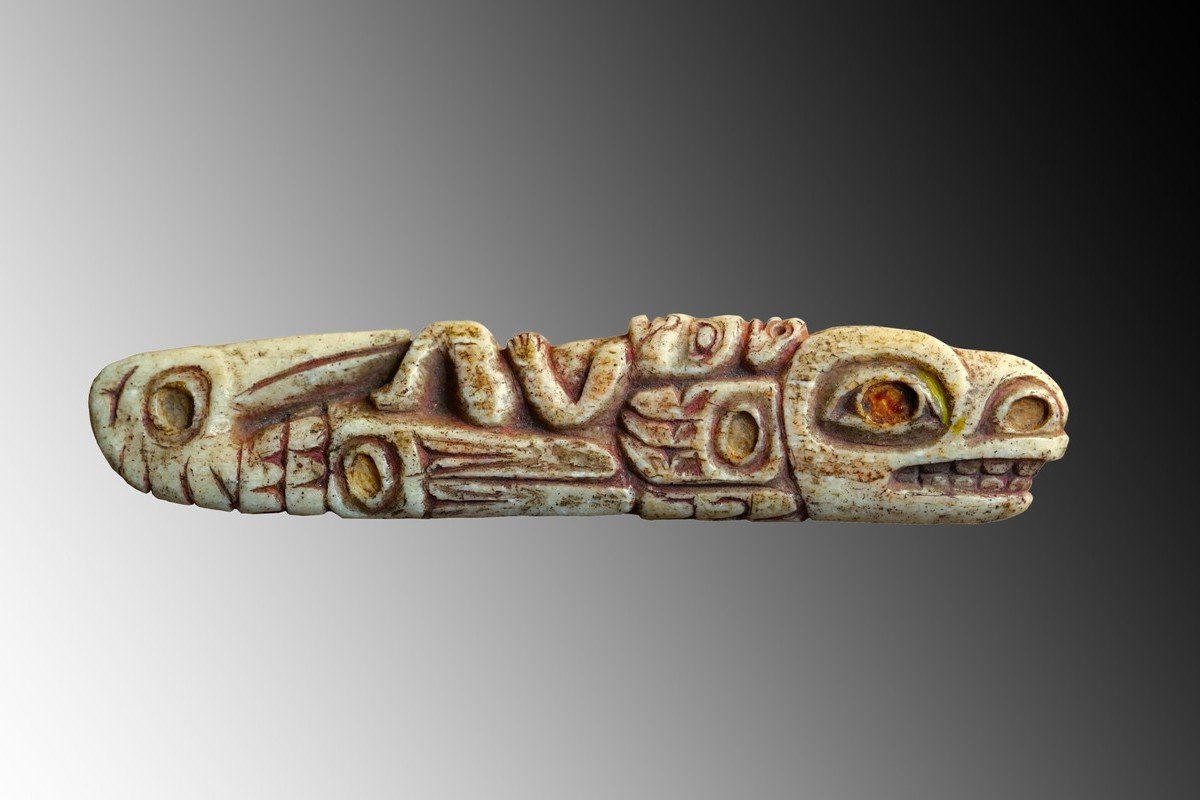
Marine mammal bone, traces of red pigment
Dimensions: Length: 20.5 cm
Estimated date:19th century
Tlingit people
Southern Alaska, USA
Source:
Private American collection
Yann Ferrandin Collection, Paris
Before the end of the 19th century, various forms of shamanism were widely practiced throughout the Northwest Coast. Shamans played a central role in the personal and spiritual lives of their communities: they were responsible for healing the sick, ensuring an abundance of food, warding off evil spirits, and providing assistance in battle.
Tlingit shamanism was particularly complex. Numerous amulets, primarily made of bone, were used and sometimes crafted by shamans; they were typically incorporated into a necklace or attached to a garment. We also know that bone amulets were sometimes attached to tunics.
This exceptionally large sculpture shows no signs of drilling or any other fastening or hanging mechanism; it likely belonged to an important member of a clan or family and served as a personal talisman, kept in a leather pouch.
Shamanic amulets typically depict benevolent spirits encountered during vision quests or in dreams. Each amulet is unique, often consisting of a central image interwoven with several secondary figures.
In the remarkable example we are presenting, the main image likely depicts an orca, its mouth open to reveal a row of teeth. The pectoral fins are depicted. The Tlingit regard the orca (keet) as the powerful guardian of the sea, a sovereign supernatural being, and the embodiment of ancestors or reincarnated great chiefs.
In place of the animal’s dorsal fin is a crouching figure with its hands on its stomach. This depiction of a guardian spirit is found on large totem poles or on posts placed inside homes. This position, with the knees drawn up toward the stomach, often expresses a stillness charged with energy, ready for action or shamanic transformation. The hands on the stomach symbolize the connection to the “
”—the “center of life,” of breath, and of the spiritual lineage. This refers directly to the transmission of rights, clan titles, and stories passed down from generation to generation. This figure is surmounted by a small head, likely representing a protective spirit.
At the other end is depicted a bird with a long beak, its neck adorned with feathers. This could be a depiction of the great blue heron, which holds significant symbolic importance among the Tlingit, linked to social structure, origin myths, and behavioral lessons from nature. The heron is deeply respected for its hunting skills.
Tlingit society is divided into two major halves (the Ravens and the Eagles), which are themselves subdivided into numerous family clans. The major animals of the environment serve as emblems to display a clan’s family history and lineage during potlatches. The heron is one of these sacred creatures, also depicted on totem poles, ceremonial blankets, and wooden tableware to affirm the clan’s privileges and spiritual connection to the animal world.
For further information, please contact us at
(+33)(0) 6 07 23 33 60, or leave us a message:
Galerie Franck Marcelin – 70 chemin du Moulin – 13510 Eguilles – mob: (+33)(0)6 0723 3360 – franckmarcelin@sfr.fr – copyright © 2024