
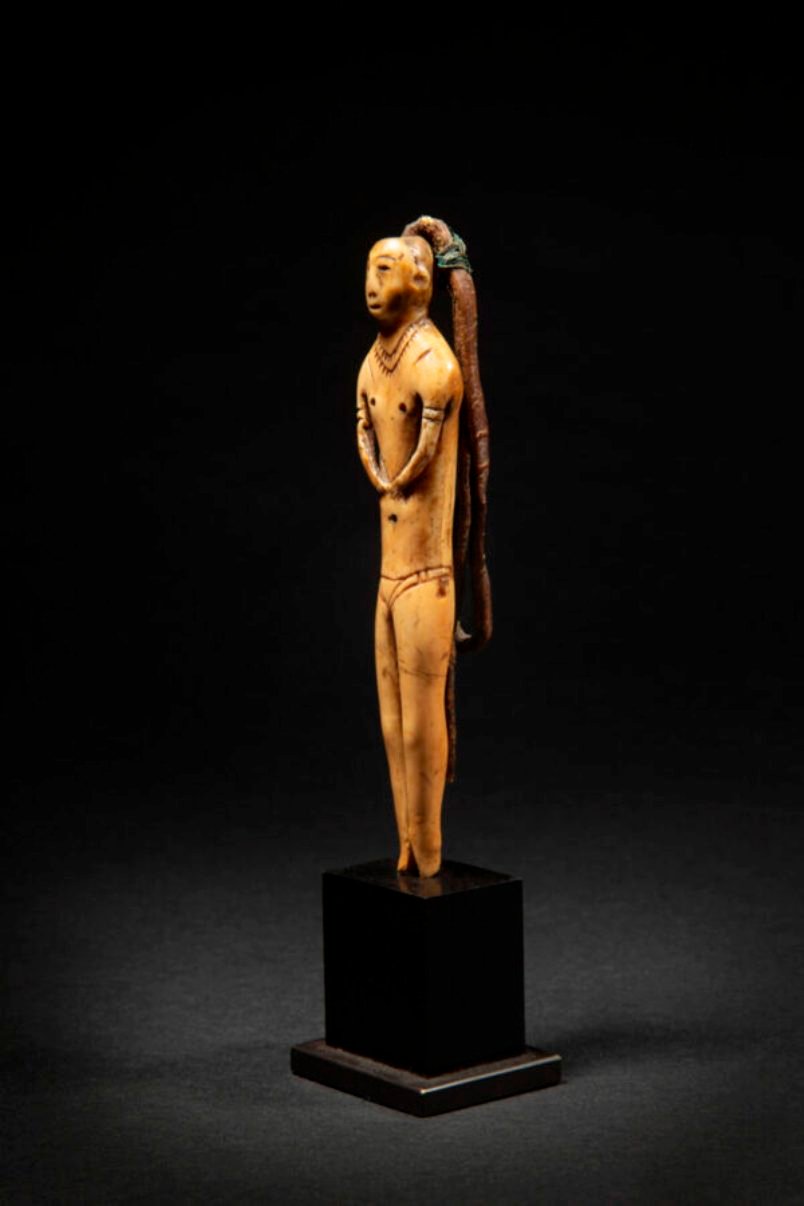
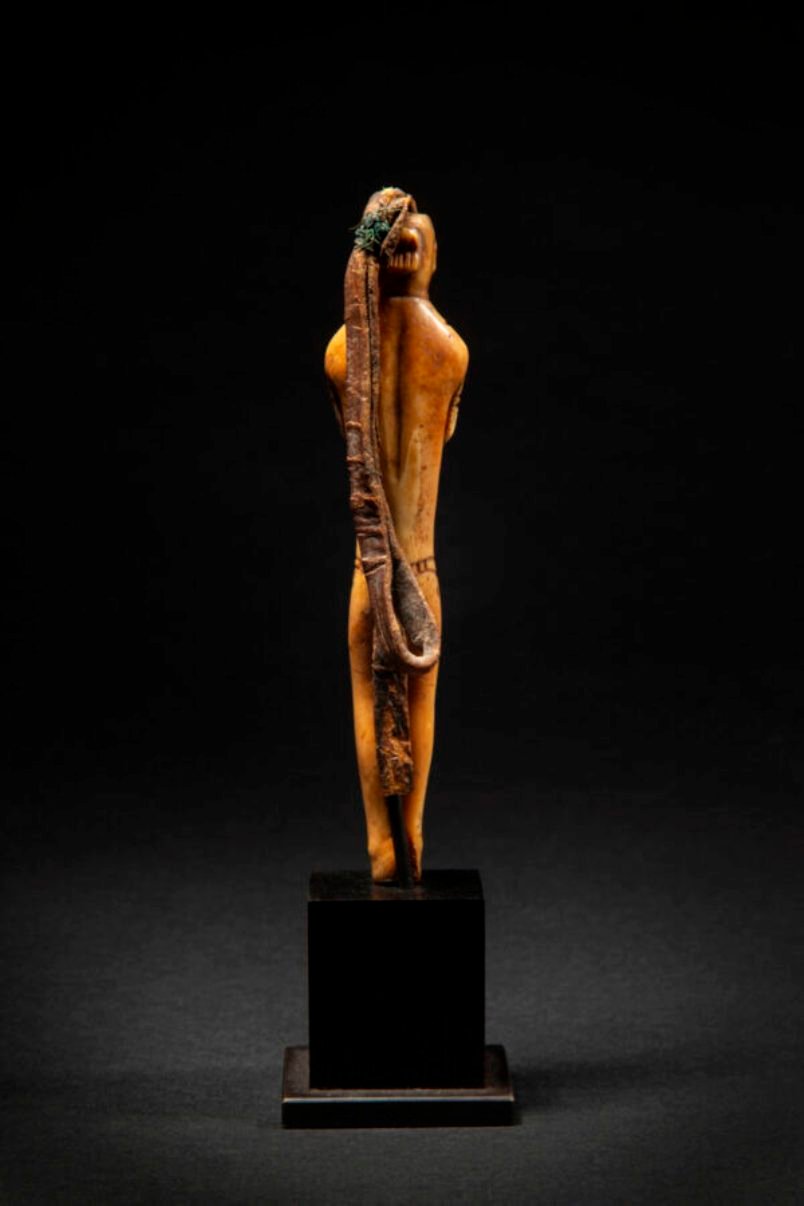
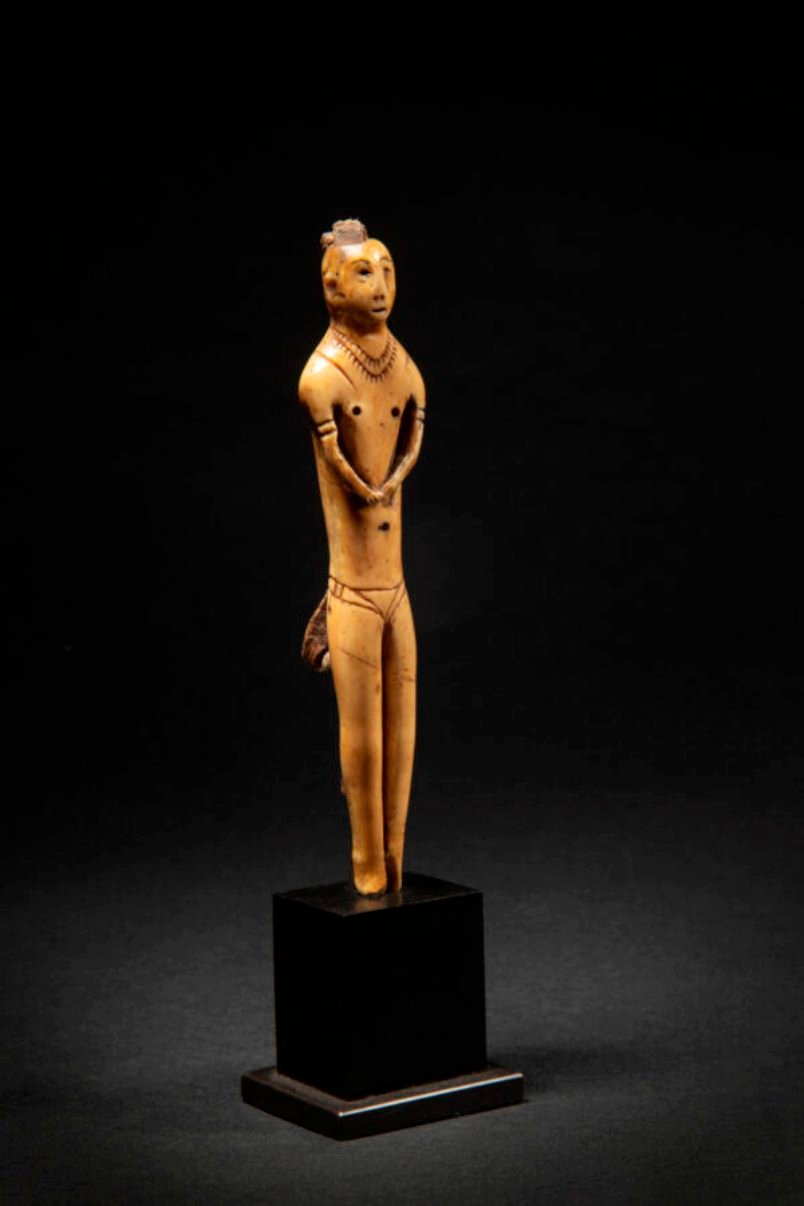
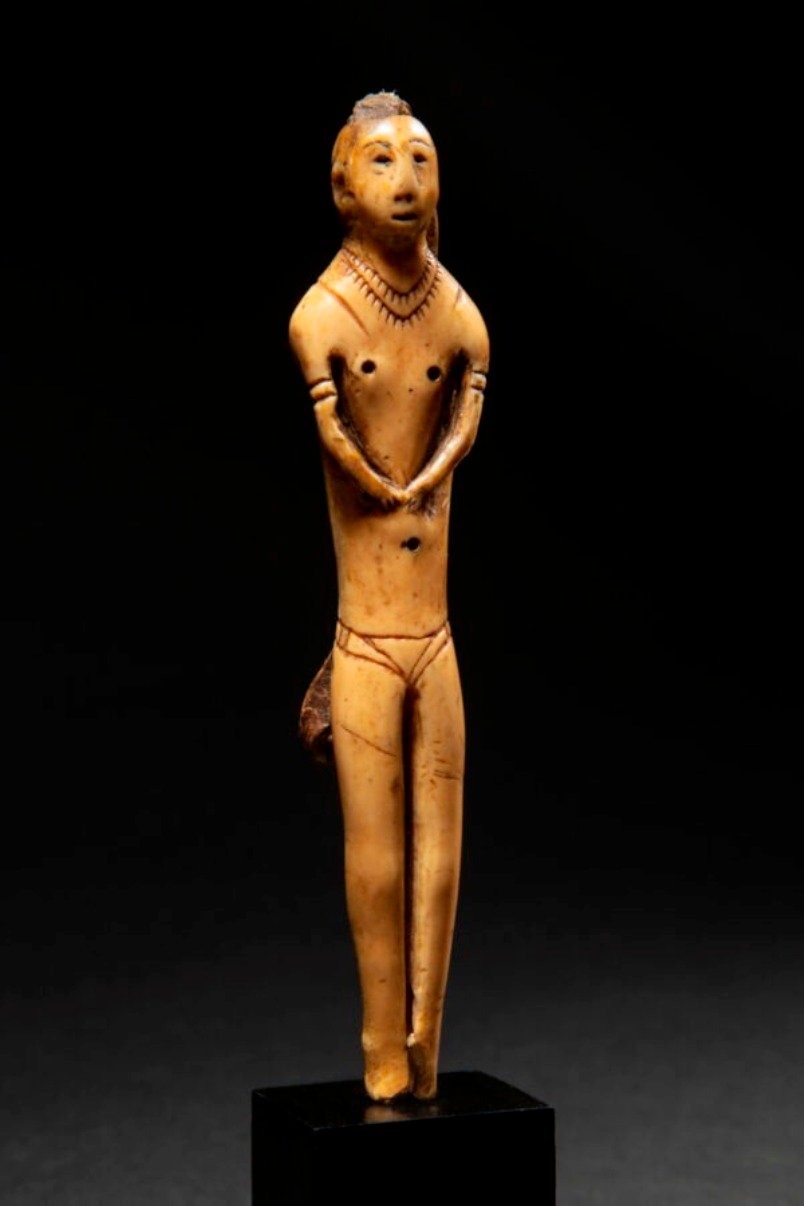
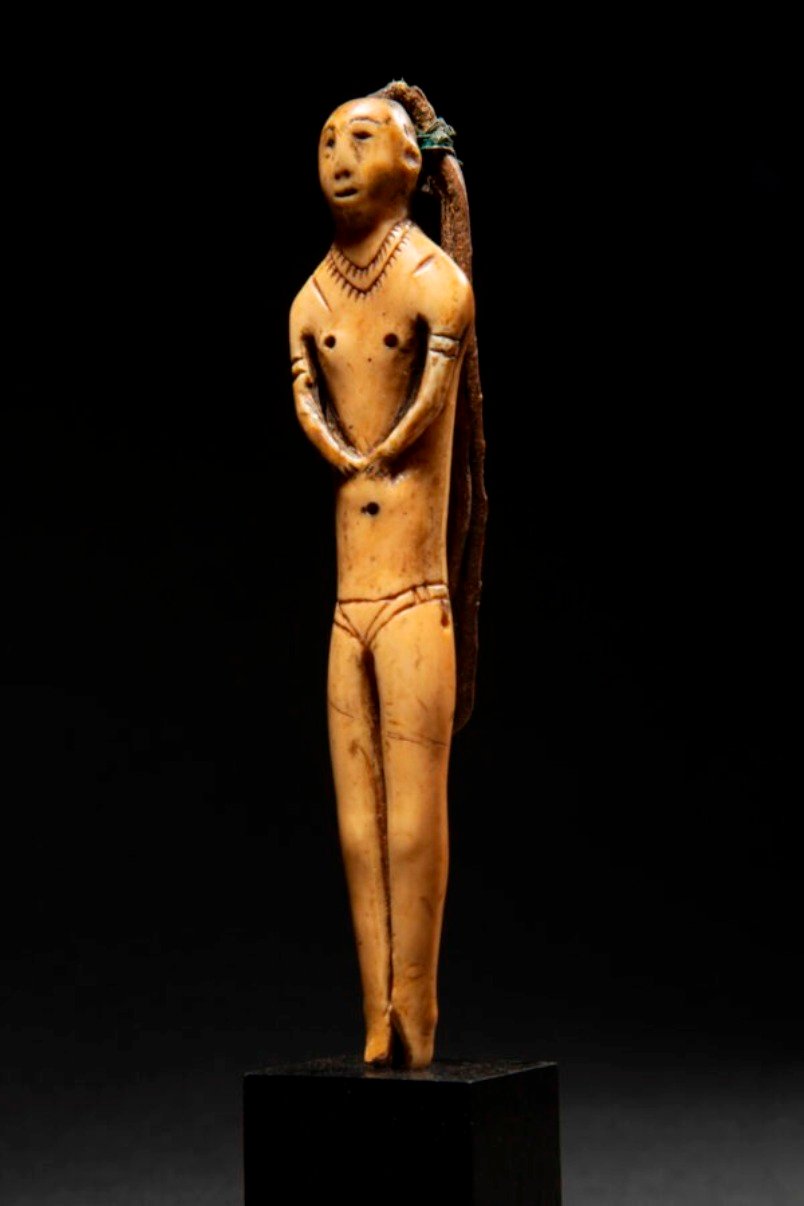
Walrus tusk (Odobenus rosmarus), leather
. Dimensions: Height: 13 cm
. Estimated date: 12th–16th century
. Thule culture, ancient Eskimo
, Alaska, USA
Provenance
; Jeffrey R. Myers Collection, New York
; Amy & Elliot Lawrence Collection, New York, acquired from the previous owner
; Sotheby’s New York, American Indian Art, January 18, 2023, lot 710
; Galerie Flak Collection, Paris
; Guy Porré and Nathalie Chaboche Collection, acquired from the previous owner
Publication
Art of the Ancestors: Antique North American Indian Art, Aspen Museum of Art, George Everett Shaw, 2004, reproduced on p. 85
According to Fitzhugh and Kaplan (in *Inua: Spirit World of the Bering Sea Eskimo*, 1982: 156), ivory carvings were used to symbolize the presence of certain important members of the village or clan when they had to leave the village temporarily (particularly for hunting or fishing expeditions). These figures also served as fertility charms and could be used during ancestor worship. Finally, they were intended to attract the attention of the inua (spirit) of the animals to ensure the success of hunting and fishing expeditions.
Sewing kits are an essential item for hunters in the Arctic regions. In such a hostile environment, sewing kits are indispensable survival tools for local populations.
These kits typically included copper needles, ivory, or bone, tendon thread, an awl, a thimble, leather for storing the needles, a bone or ivory needle case, and a bone button for attaching the case to a garment. Every traveler, man or woman, carried one, because even the smallest tear in a kayak’s skin hull required immediate repair. The hunter then had to sew and repair it on the spot without delay.
Designed to maintain clothing suited to extreme conditions, the needle and its case were, according to Amber Lincoln, curator at the Sainsbury Centre (Norwich, United Kingdom), “without a doubt the most important technology in the Arctic, period.” ” This importance was reflected in the care taken in their manufacture, with finely carved cases designed to protect the delicate bone needles.
As Steven Hooper notes in *The Robert and Lisa Sainsbury Collection, Vol. 2: Pacific, African, and Native North American Art* (Yale University Press, 1997, p. 248), needle cases depicting a human figure are extremely rare.
For further information, please contact us at
(+33)(0) 6 07 23 33 60, or leave us a message:
Galerie Franck Marcelin – 70 chemin du Moulin – 13510 Eguilles – mob: (+33)(0)6 0723 3360 – franckmarcelin@sfr.fr – copyright © 2024