
Yellow cedar, yew (or alder), spruce root,
cedar bark, iron nail
Dimensions: Height 30 cm, width 13 cm
Estimated date:19th century
Haida people
Haida Gwaii (Queen Charlotte Islands)
British Columbia
Canada
Provenance:
Private collection, Canada
Adam Prout Collection, London, Great Britain
Private collection, Belgium
Andrey Tischenko Collection, Helsinki, Finland
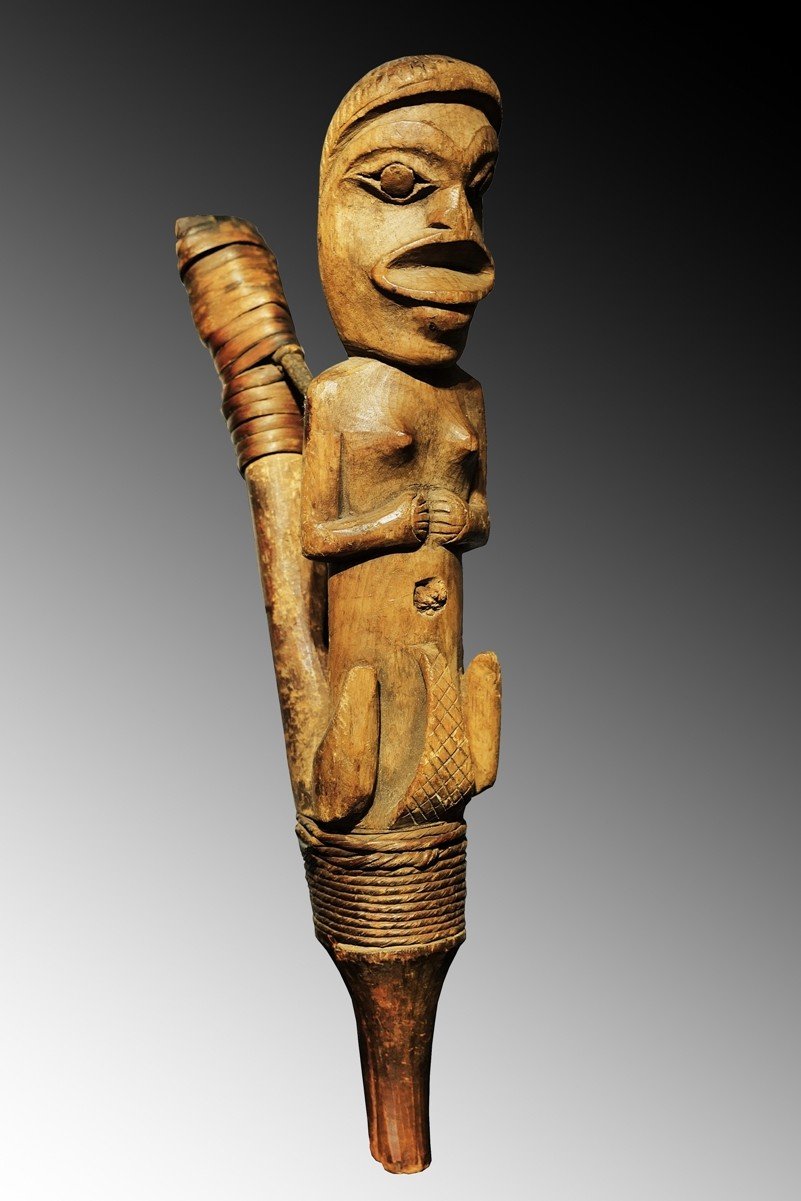
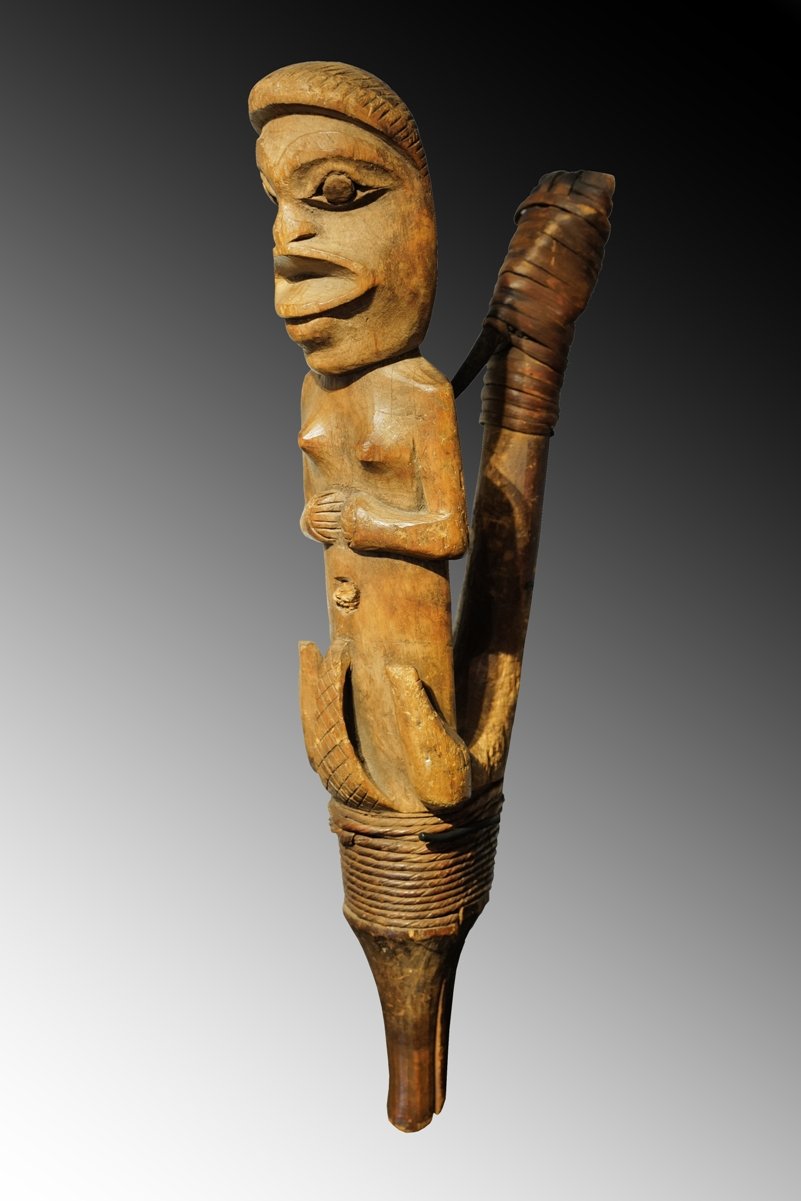
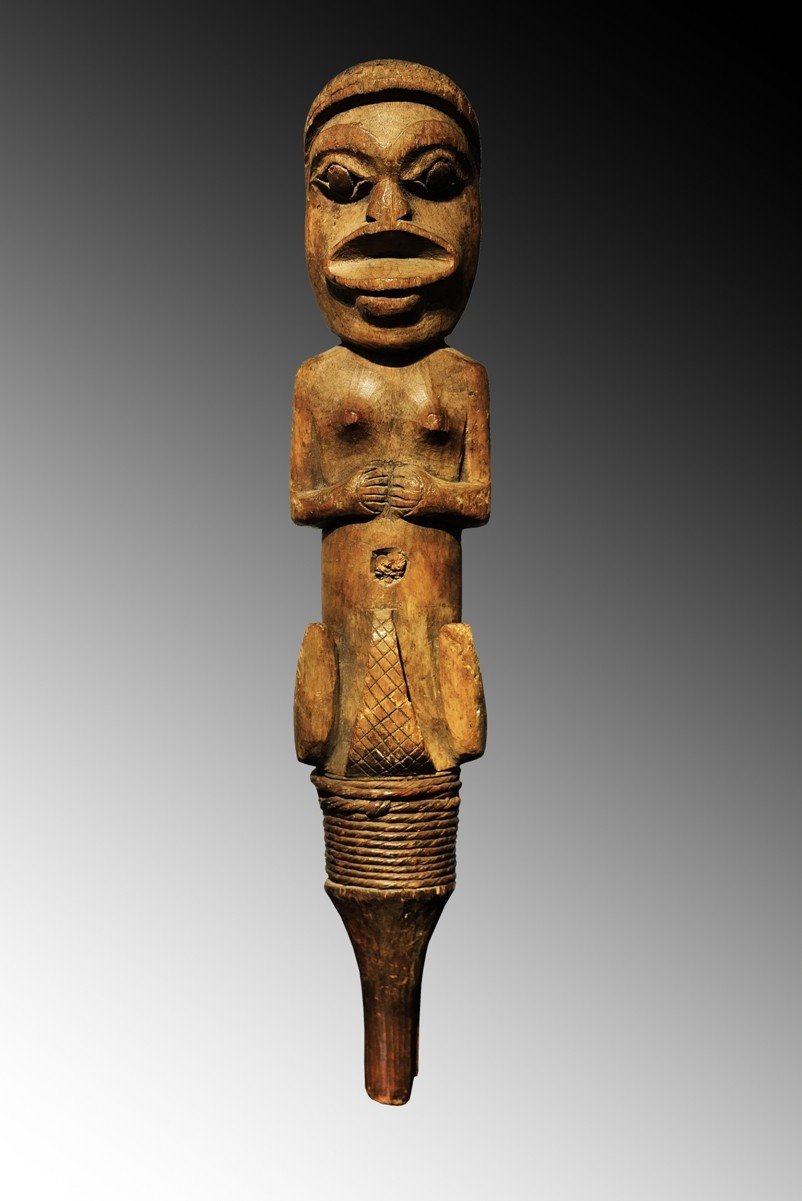
Called “ýagw táawaay” (in the Haida dialect), our fishhook is meticulously carved on the lower arm of a shaman transforming into a river otter(1), a protective spirit endowed with supernatural powers.
According to tradition, these anthropomorphic designs and spirits (which always have carved eyes so that the hook “looks” at its prey) serve to honor and entice the halibut, encouraging it to bite the most aesthetically pleasing hook.
The shaman possesses powers and moves with ease between the natural and supernatural worlds. He is believed to help fishermen make an equally harmonious transition between land and sea.
Malindine (2) points out that many of the animals carved on the fishhooks are actually capable of moving between different environments, citing in particular the river otter, which “can swim almost like a fish and run through the forest like a rabbit.”
This type of fishing hook is a masterpiece of engineering and traditional spiritual art unique to the Indigenous peoples of the Pacific Northwest, including the Haida, Tlingit, and Tsimshian.
Although it may appear to be a purely decorative object in museum or private collections, its asymmetrical “V” shape is a model of eco-responsible management
The precise “V” spread is designed to catch only medium-sized halibut (between 10 and 45 kg). This spares juveniles and very large brood fish (females weighing over 200 kg, which are essential for reproduction), allowing them to slip off the hook unharmed, thereby ensuring the species’ long-term survival.
Before casting the hook into the water, the fisherman speaks to it and encourages it to carry out its task bravely.
Weighted down by a stone at the bottom of the water, the hook floats about one meter above the seabed thanks to the buoyancy of yellow cedar, the type of wood used for the upper arm that holds the iron barb (the lower arm, made of yew or alder—which is heavier—features the carving). The halibut does not “nibble” but sucks in the bait (often octopus or herring meat). Upon detecting a foreign object in its mouth and trying to spit it out, the barb becomes firmly lodged in its jaw.
The most elaborately decorated fishhooks, such as ours, were also used during ceremonies or displays of family prestige (potlatch).
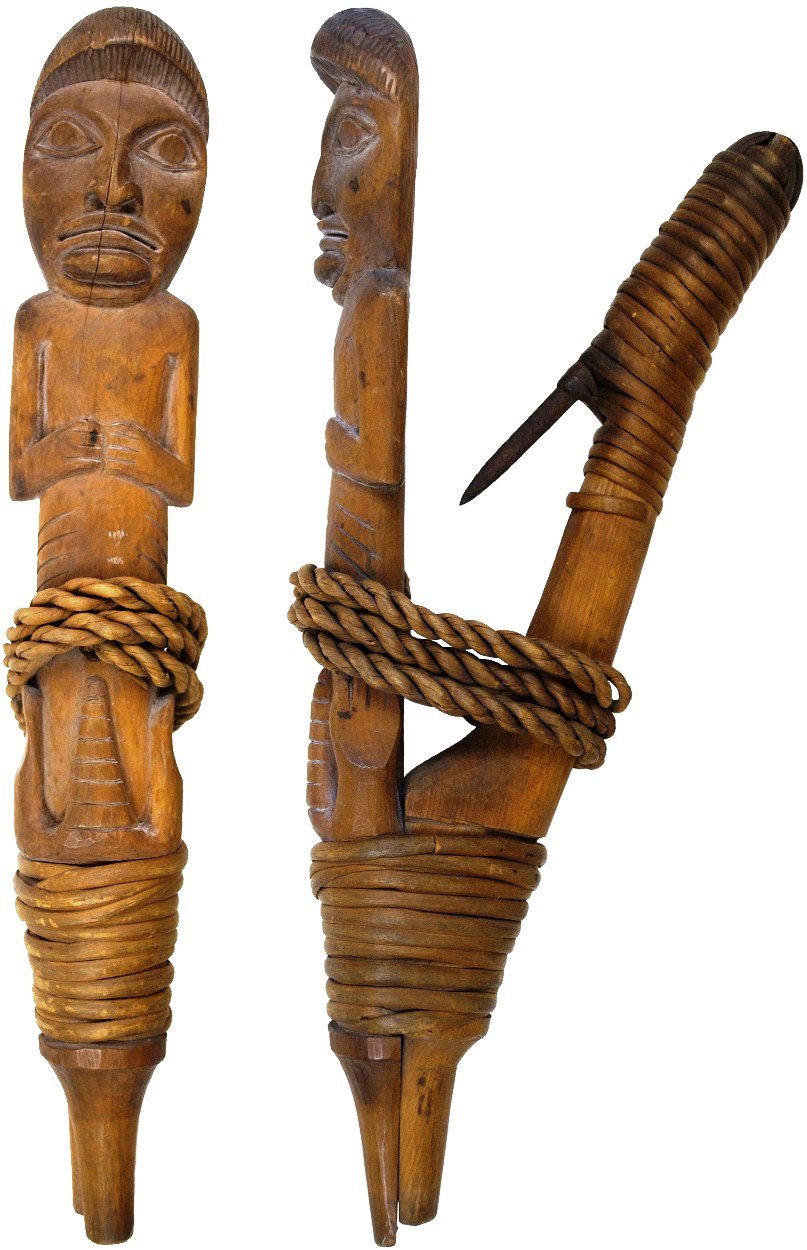
1 – A very similar piece, likely carved by the same artist and measuring 28.5 centimeters in length, from Haida Gwaii, was acquired in 1937 by George Gustav Heye.
It is housed at the National Museum of the American Indian of the Smithsonian Institution
(Inv. 19/6270). See Photo 1
2 – Malindine, Jonathan. Northwest Coast Halibut Hooks: An Evolving Tradition of Form, Function, and Fishing (Hooks for Northwest Coast halibut: an evolving tradition of form, function, and fishing.) Human Ecology. ResearchGate,
Columbia Museum of Anthropology, Missouri. February 2017
Available at: www.researchgate.net/publication/313089299_Northwest_Coast_Halibut_Hooks_an_Evolving_Tradition_of_Form_Function_and_Fishing#read.
Photo 1: Smithsonian Institution’s National Museum of the American Indian
For further information, please contact us at
(+33)(0) 6 07 23 33 60, or leave us a message:
Galerie Franck Marcelin – 70 chemin du Moulin – 13510 Eguilles – mob: (+33)(0)6 0723 3360 – franckmarcelin@sfr.fr – copyright © 2024