
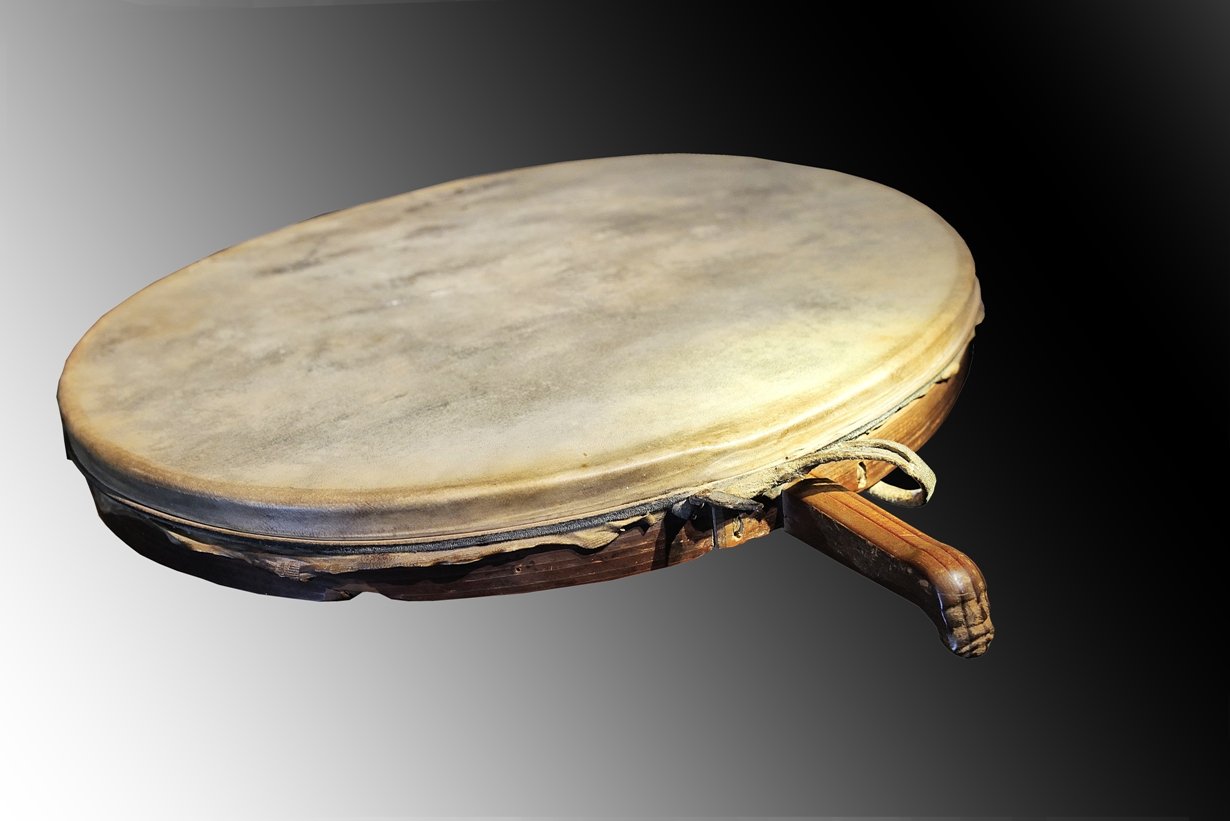
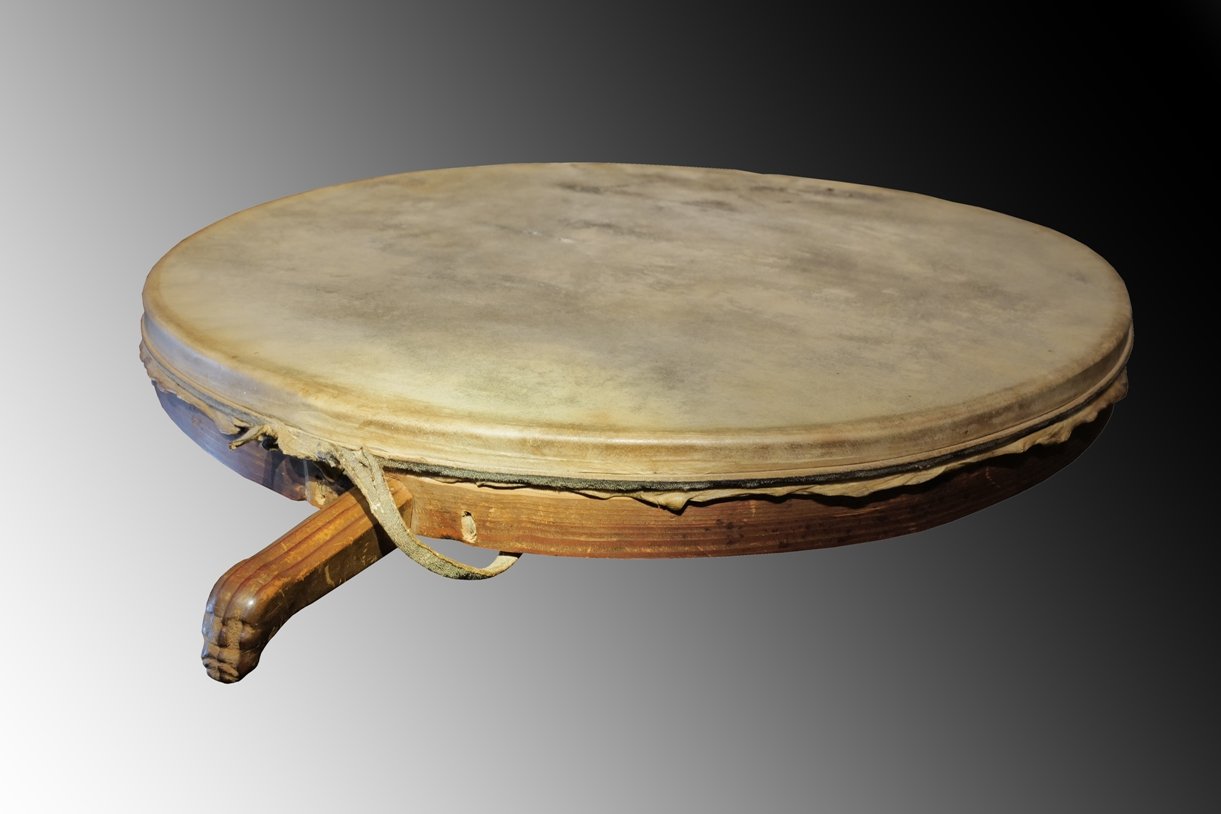
Driftwood (white spruce or larch), leather
Dimensions: 50 cm including the handle
Presumed date:19th century
Inuit people
Ammassalik District, Tasiilak
Eastern Greenland
Source:
Private collection, Denmark
Photos:
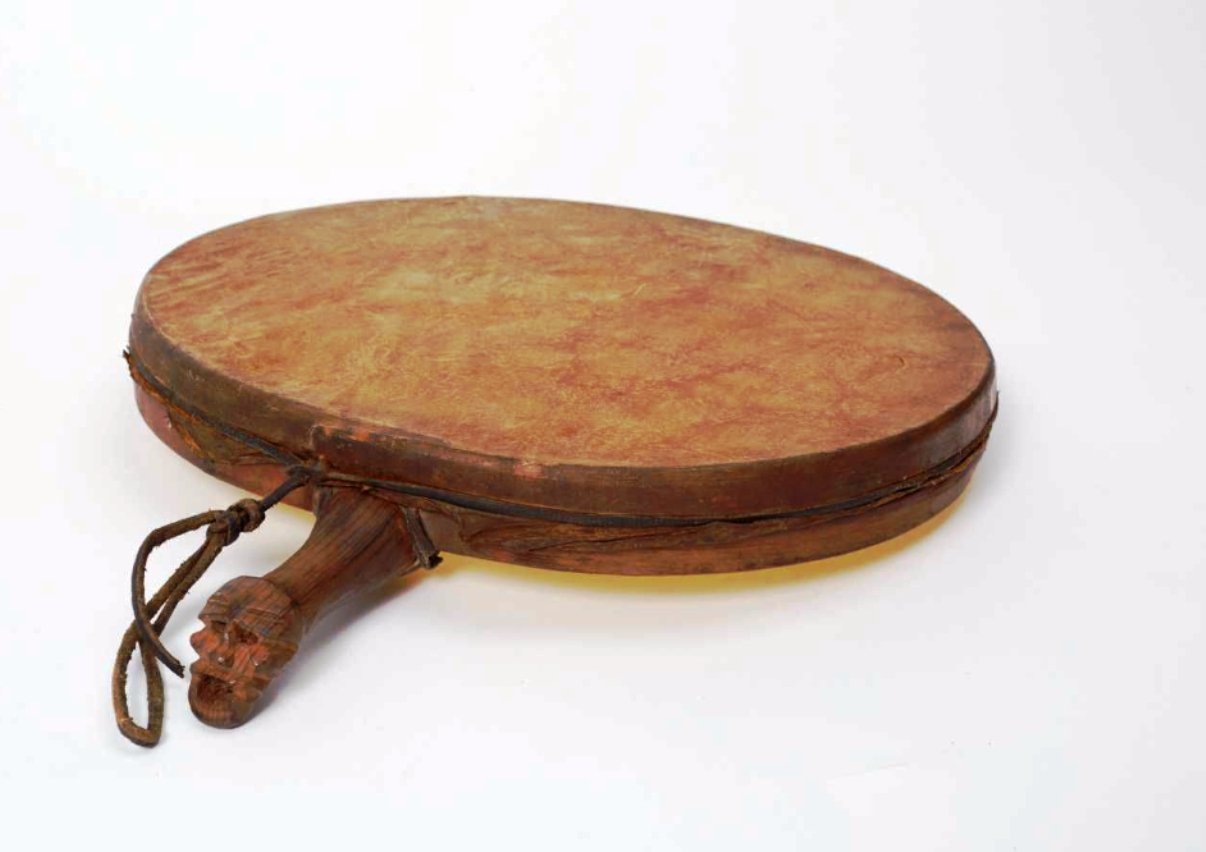
1—Drum in the collection of the National Museum of Denmark (Inv. No.: L19.183). Photographer Mads Kildegaard Nielsen
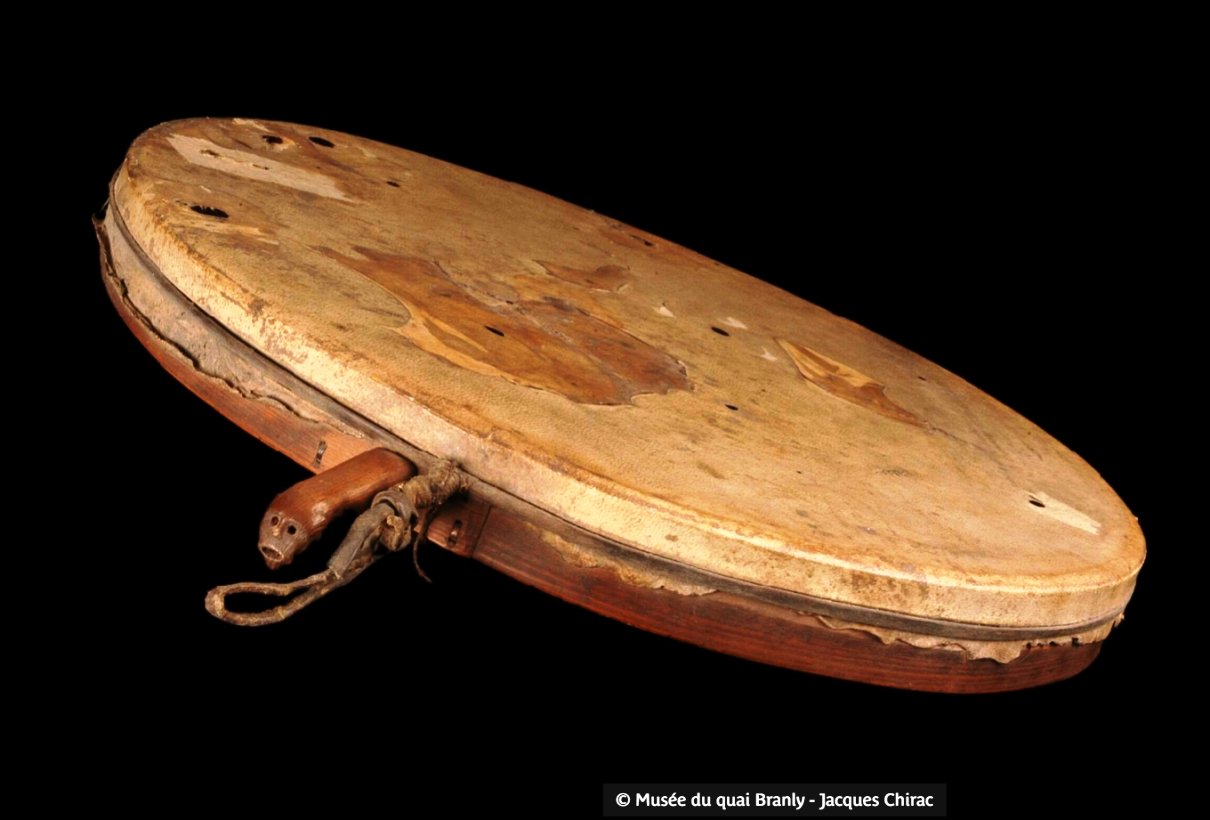
2. Drum housed at the Quai Branly-Jacques Chirac Museum (Inv. No.: 71.1934.175.2896)
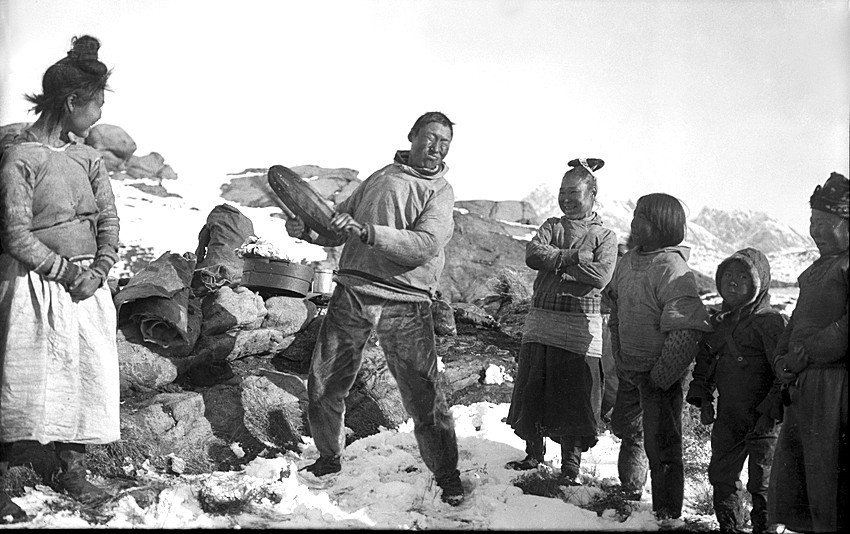
3- The 1906 photograph of the Ammassalik drum dance, taken by explorer Knud Rasmussen and held by the Arctic Institute (Arktisk Institut), documents the ancestral Inuit tradition of drum singing and dancing (qilaatersorneq) in eastern Greenland
Known as a qilaat, or qidat according to Paul Émile Victor, the Ammassalik drum is made from a thin membrane taken from the lining of the stomach or peritoneum of a seal or walrus. This membrane is stretched around the frame using a seal-skin strap attached to a wooden hoop that has been cut into a thin strip and then bent using steam, hot water, or fire.
What makes the Ammassalik drum unique is that the drumstick is used to strike the wooden frame rather than the drumhead, which is too thin and fragile.
Among the Inuit of this region, the drum had two fundamentally distinct uses: one secular, the other religious.
In secular tradition, “singing contests” or “dancing contests” took place during the summer migration season (between April and October).
Most often during the large community gathering in May and June for fishing.
During satirical song and dance contests, the drum was used to settle a dispute between two men or two women in front of spectators who acted as a court of law.
The drum was also used in the winter, in the single room of the large patriarchal house.
After a communal meal of aged seal meat—which likely had euphoric effects—the crowd broke into impromptu songs and dances set to the rhythm of drums.
Sometimes the men would wear masks, and late into the night, there would be a succession of solo songs—long, epic poems of sorts—songs with choruses sung by the audience, or even short theatrical skits.
Finally, in religious practice, the qidat accompanied the shaman’s trances and spiritual journeys. It was indeed through the drum that the shaman summoned his helper spirits or communicated with the supernatural powers that rule the human and animal worlds and are responsible for the winds and the ice. He would then attempt to make amends to restore the disrupted order on earth: illness, poor hunting, etc.
Shamanic drums were always adorned with a figurine depicting a face at the end of the drum’s handle. This was not necessarily the case for drums used solely for secular purposes.1
Our drum is unique in that it features a handle adorned with a small carved human head, similar to the one on the drum in the collections of the National Museum of Denmark (photo 1) or the one at the Musée du Quai Branly–Jacques Chirac (photo 2).
In their efforts to Christianize the region, the pastors condemned everything outright—drums, masks, dances, and songs—as contrary to the morality and religion they taught. Shamanic practices disappeared upon the death or conversion of the shamans.2 As for the cultural heritage of songs, poems, and theatrical skits—transmitted through oral tradition and preserved without the knowledge of religious authorities—it has dwindled over time and survives today only in a faint remnant.
Notes:
1- Paul Emile Victor & Joëlle Robert-Lamblin. The Seal Civilization. Volume 1 : Games, Gestures, and Techniques of the Ammassalik Inuit, page 172. Published by Armand Colin-Raymond Chabaud, 1989.
2- During the French Greenland Expedition (1934–1935) According to Paul Emile Victor, the drums used in shamanic rituals had completely disappeared.
For further information, please contact us at
(+33)(0) 6 07 23 33 60, or leave us a message:
Galerie Franck Marcelin – 70 chemin du Moulin – 13510 Eguilles – mob: (+33)(0)6 0723 3360 – franckmarcelin@sfr.fr – copyright © 2024