
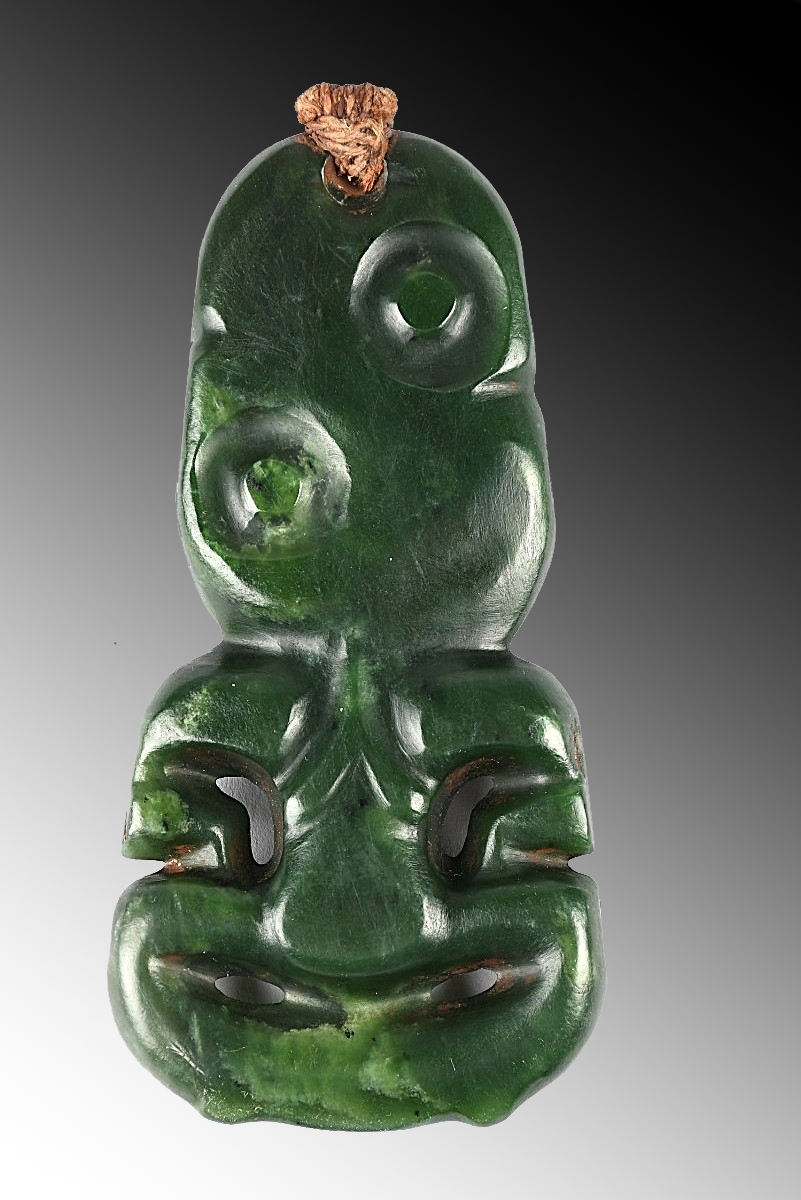
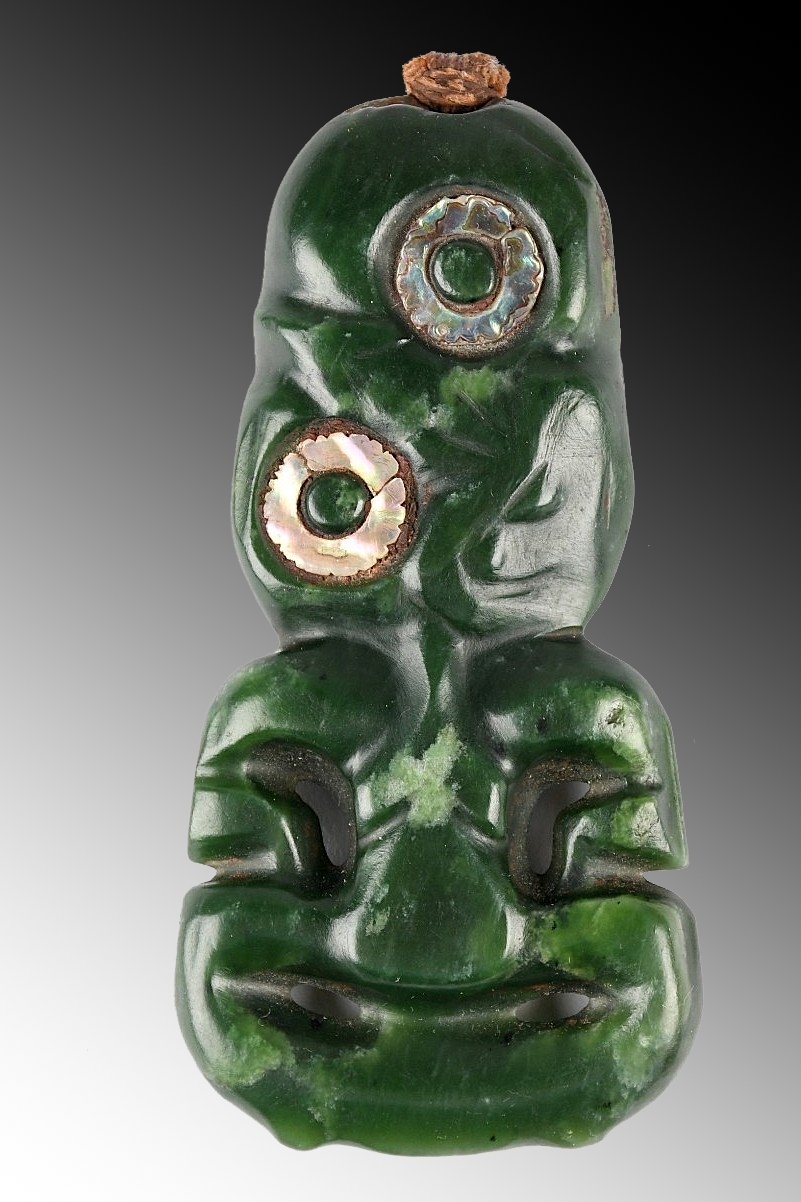
Inanga-variety pounamu nephrite, paua shell mother-of-pearl (abalone, *aliotis iris*).
Remnant of a linen cord
Dimensions Height: 10.6 cm
Estimated period: Te Puawaitanga period (1500–1800)
Māori people
New Zealand
Provenance:
Private collection, United Kingdom
Martin Doustar Collection, London
Reserved
There are very few examples of hei tiki that are carved on both sides.
An 8-centimeter-tall model is housed at the Te Whare Taonga o Waikato Museum in Hamilton (Inv. No. 1964/56/1)
A second model, also measuring 8 cm, is housed at the Museum of New Zealand Te Papa Tongarewa in Wellington
(Inv. No. ME004798).
The Tuhura Otago Museum in Dunedin (Inv. No. D.36.901) has a similar model measuring 11.9 cm
The British Museum in London (Inv. No. Oc1906,0416.1) has an 11-cm model which, according to the curator’s note, is listed in old museum records under the name Kaupwina, meaning “two stomachs.”
Regarding the Hei tiki in the British Museum’s collection, T.A. Joyce wrote the following in his “Note on a Very Unusual Form of Tiki from New Zealand,” published in 1906: “It seems a bit hard to understand why, given the enormous amount of time and energy required to make a single tiki under the conditions of the past, so much effort was put into the back of an object—especially an ornament that, given its position on the chest, could only be seen from one side. Of course, the tiki was regarded, if not as a talisman in the strict sense, at least as possessing talismanic properties; and it may be, as Professor Ridgeway suggests, that the duplication of the figure was intended to double the ornament’s protective powers. The tiki is clearly a fine, ancient specimen, and the design is, to my knowledge, unique—at least I can find no mention of a similar specimen elsewhere. I would be happy to learn if such a piece exists in a public collection.”
Our Hei Tiki was carved from a pounamu adze blade; pounamu is also known as greenstone, nephrite, or, more generally, jade. As suggested by the flat outer edges of the arms and legs
Haliotis mother-of-pearl was used to create the eyes, which are believed to watch over the wearer and offer protection. It is still preserved on one side.
The top features a biconical mounting hole. Traces of fiber binding remain.
The overall structure is of a classical design
The large head is tilted to the right. The hands rest on the thighs, while the knees are bent so that they touch the feet.
The Te Puawaitanga period is the historical era during which Māori art reached its peak.
Discovered in the riverbeds along the west coast of New Zealand’s South Island by Māori settlers around the 13th century, Pounamu was so highly valued that the Māori named the South Island Te Wāhipounamu (The Waters of the Green Stone).
Carefully preserved in waka huia treasure boxes, the hei tiki was worn around the neck by high-ranking men and women as a symbol of social status and prestige. Considered a taonga tuku iho (precious heirloom), it was passed down from generation to generation.
After its owner’s death, it accompanied him to his grave until it became imbued with his mauri (life force). Then, after a certain period of time, the hei tiki was finally entrusted to one of his descendants so that he or she could wear it in turn, ensuring that it would continue, life after life, within the same cycle of transmission, always remaining within the same family. A symbol of the connection to the tupuna ( ancestors), the hei tiki had the power to enhance women’s fertility but also to ward off malevolent spirits, particularly for men during armed conflict.
Literature
– T.A. Joyce, in his “Note on a Very Unusual Form of ‘Tiki’ from New Zealand, ” *
Man*, Vol. 6, 1906, No. 53, pp. 80–81, published by the Royal Anthropological Institute of Great Britain and Ireland
– Starzecka, Neich & Pendergrast 2010 / *Taonga Māori in the British Museum* (no. 283, pls. 69 and 70) British Museum
– H.D. Skinner, *The Maori Hei-Tiki*, Otago Museum, Dunedin, 1966
– Quai Branly-Jacques Chirac Museum. The Sacred Stone of the Māori. May 23–October1, 2017
For further information, please contact us at
(+33)(0) 6 07 23 33 60, or leave us a message:
Galerie Franck Marcelin – 70 chemin du Moulin – 13510 Eguilles – mob: (+33)(0)6 0723 3360 – franckmarcelin@sfr.fr – copyright © 2024