
Wood
Height: 193cm
Presumed date of origin1 : 18th century
Population Yiman
Korewori River
Middle Sepik Province
Papua New Guinea
Provenance:
Wayne Heathcote Collection, USA, United Kingdom
Christie’s, Paris. June 19, 2014, lot 103
Private collection
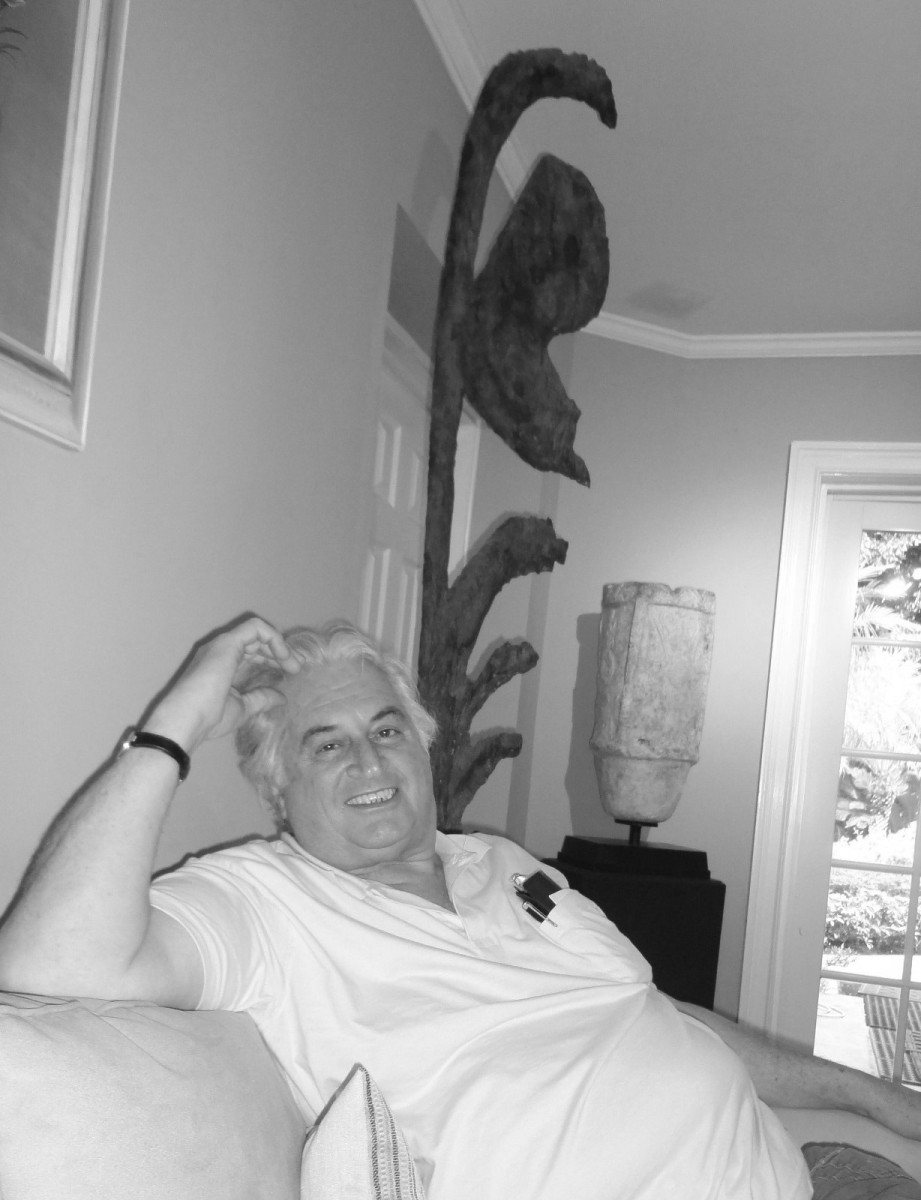
photo caption:
Wayne Heathcote in his home with the yipwon
The first yipwon to reach the West appears to have entered Berlin’s Museum für Völkerkunde in 1913, along with many other objects collected by the Kaiserin-Augusta-Fluss Expedition on the banks of the Sepik and some of its tributaries.
But it wasn’t until May 24, 1959, when they landed on the right bank of the Korewori, a southern tributary of the Sepik, at the point where the 1912-1913 expedition had turned back, that Alfred Bühler, dispatched by the Museum für Völkerkunde in Basel, assisted by Anthony Forge, was able to observe a yipwon in its ritual setting, and then others over the following days as they moved deeper into the hinterland.
According to their field notes and the texts published by Bühler and Forge on their return, the inhabitants of New Chimbut, the village they had founded on leaving their rainforest, kept their yipwon in an improvised men’s house, amidst various offerings and away from female gaze2.
On-site surveys in 1961 and 1963 by Eike Haberland, Chair of Ethnology at Frankfurt University, who published a long creation myth about them in 1964, revealed the ritual importance of these monoxyle anthropomorphic figures: generally larger than the average human, they have a single leg and can only be erected leaning against a wall in profile.
In the Pidgin language, the yipwon were also called wanleks, in reference to their single leg. In the mythology of the Yimam people, reported by Haberland3: “The shavings that fell from the waist of the first garamut drum carved by the Sun, son of the Moon and primordial life-giving spirit, came to life in the form of wanlek genies.
Considered the sons of the sun, these demonic creatures, who sought hunting and war, went to live with their father in the house of men, which they never left. One day, while their father was away hunting, a relative came to visit, and the genies killed him, drinking his blood and dancing around his remains under the gaze of the Moon.
Realizing that they had been observed, the demons, seized with fear, took refuge in the men’s house, lined up against the wall and began to grow in height, where they took on the shape of wooden sculptures.
Outraged by the behavior of his offspring, the Sun left the earth, but left behind the wanleks, whose mission from then on was to guide mankind in hunting and headhunting expeditions against neighboring enemy groups”.
These are the yipwon we know today.
These large, extremely powerful sculptures were kept for generations as the property of the clans. They were placed in the men’s ceremonial house, leaning against the back wall, the most sacred area of the house’s inner sanctum4.
Representing powerful ancestral spirits, the figures served as vessels into which the spirits were summoned to aid in warfare or hunting. Each yipwon had its own name and often maintained a close relationship with one of the oldest men in the clan.
According to Eric Kjellgren’s5 description of a yipwon, the figures were largely inanimate. But before a raid or hunt, the man most closely associated with the figure would activate it by chewing a concoction of betel nut, ginger, a small amount of his own blood and substances such as excrement from the targeted game. The chewed mixture was then applied to the figure, which was also rubbed with nettles to make it supernaturally “hot”.
Spiritual approval of the planned attack or hunt was indicated by the figure turning in the direction of the target village or hunting area (perhaps held by the man in trance). If the attack or hunt was successful, the figure was thanked by smearing it with the blood of the victim or prey. If not, the yipwon figure proved useless and was left abandoned in the men’s house or thrown into the surrounding forest 6
The study of the first yipwon, collected during the Kaiserin-Augusta-Fluss Expedition and preserved in the Berlin Museum, was not published until 1968 in Kelm’s book7. In the same year, the existence of these large hooks was revealed to Western enthusiasts when Eike Haberland8 published The cave of Karawari, following an exhibition held in New York at the D’Arcy Galleries, directed by Maurice Bonnefoy. A second exhibition featuring over 80 of these figures, entitled Oceanic Art, was held at the Musée d’Ethnographie de Neuchâtel in 1970.
In the 1960s, these exhibitions were fueled by the collections of museum prospectors, art dealers and local outfitters. They surveyed the valley where the upper Korewori meanders and the surrounding hills, which are dotted with caves that served as refuges, ritual depots or even people’s homes, unearthing these often ancient ritual sculptures.
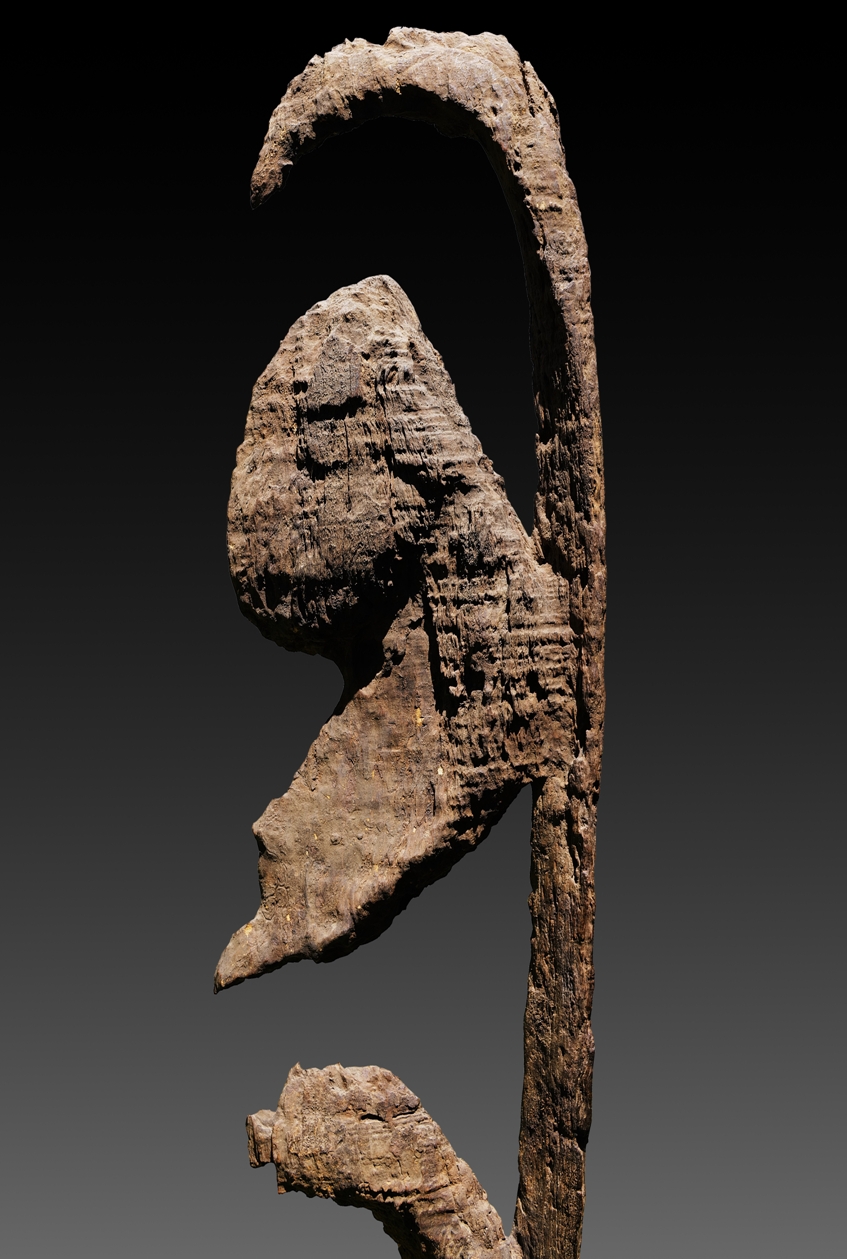
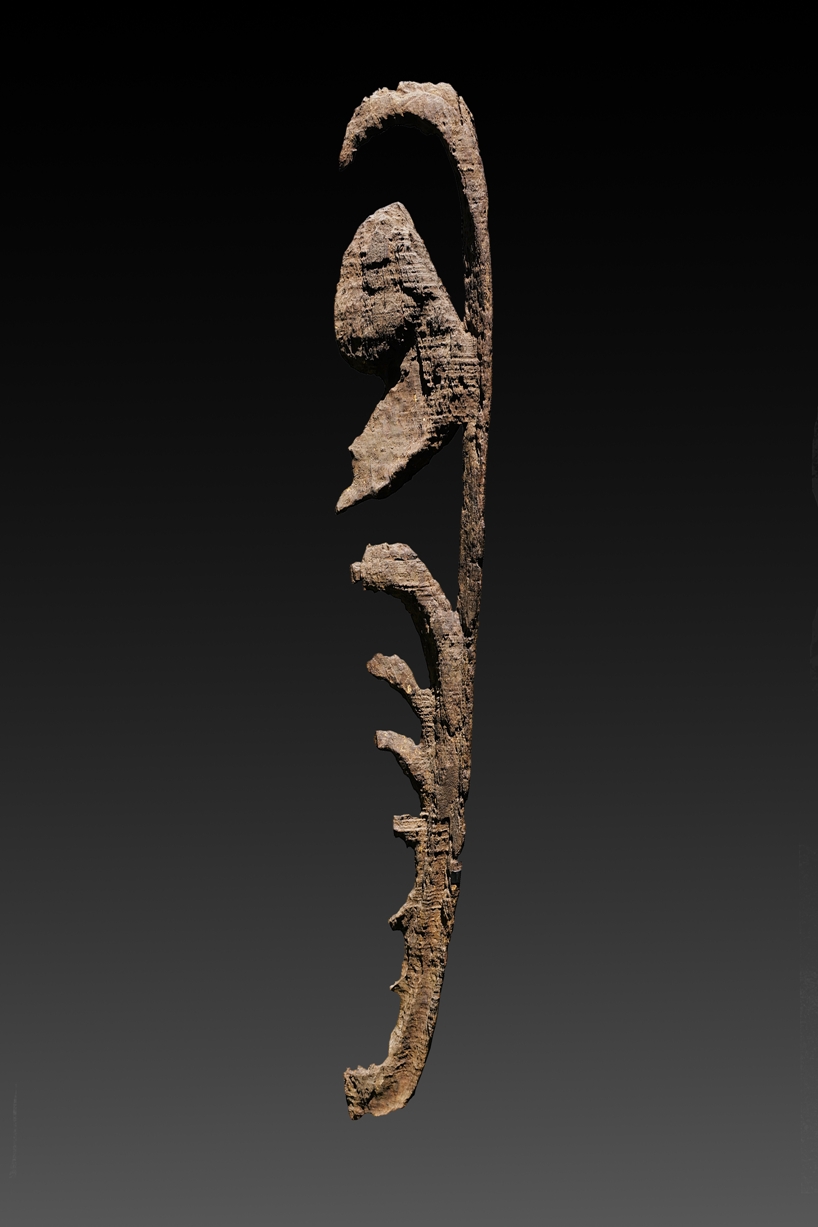
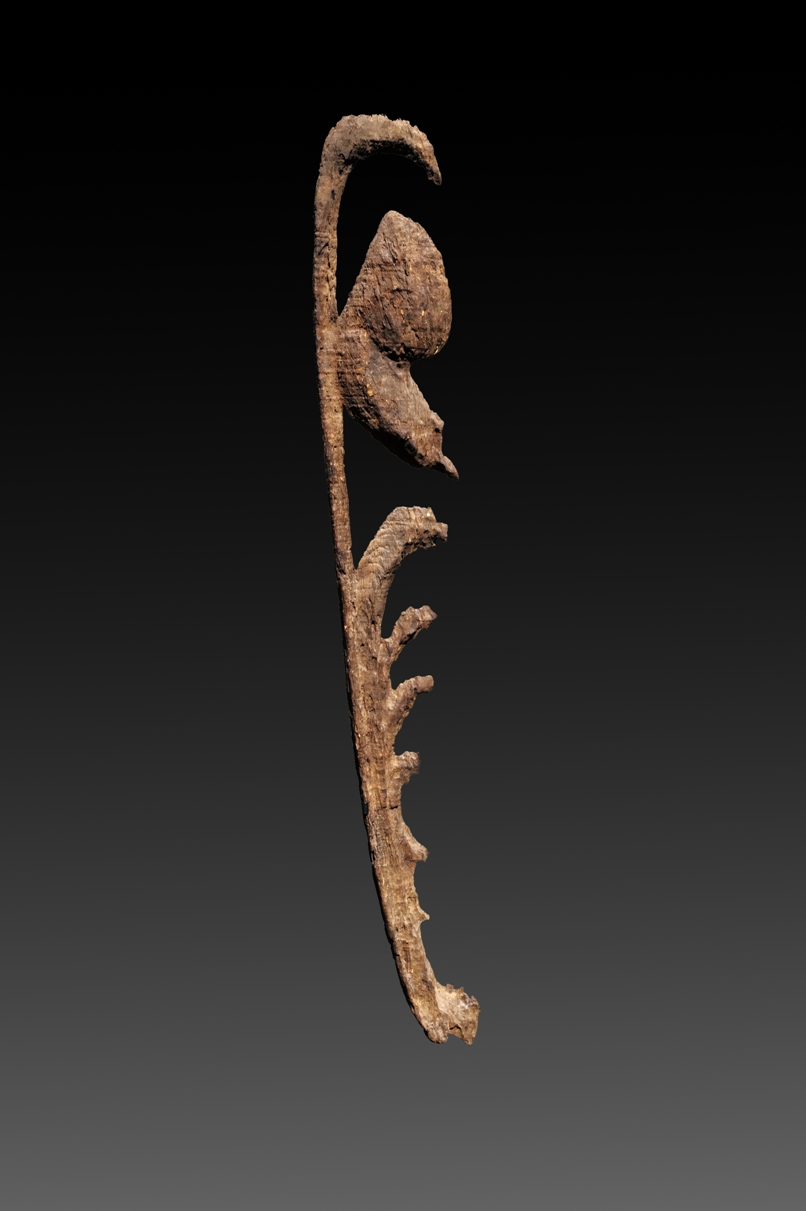
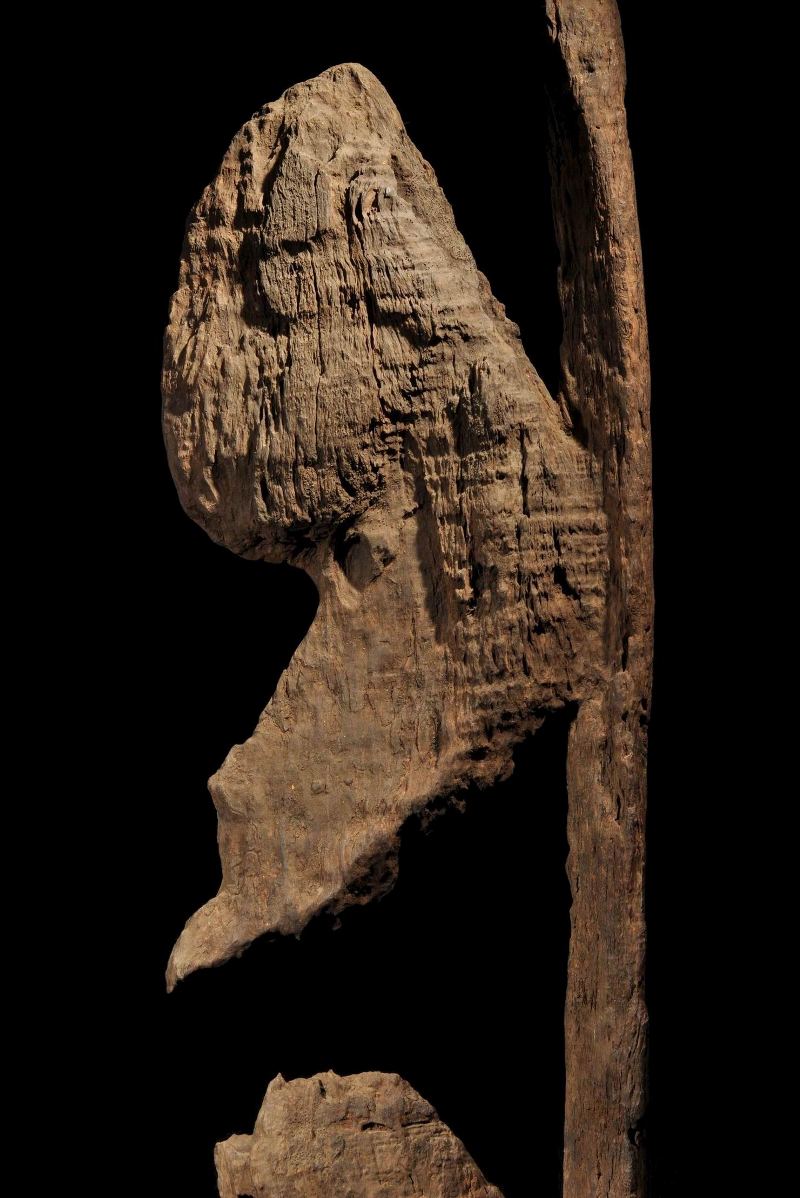
Our large sculpture features a rather naturalistic head (considered the most spiritually important part of the body) 10. The facial features are stylized, with a large forehead and a prognathic jaw. The chin is represented with a long, pointed beard. A hook-shaped crest overhangs the head, often interpreted as a feather11.
The central body, with its symmetrically inward-curving hook architecture, represents the ribs surrounding the marbleheart12. Our piece was originally fitted with a foot, which has since disappeared. The deep patina of erosion on the surface of our piece suggests that it was stored for many years in a cave.
These abstract structures fascinated Western artists as much for their aestheticism as for their novelty. They were an important source of inspiration for artists such as Henry Moore, Alberto Giacometti and Roberto Matta, who is known to have owned a yipwon13.
Notes:
1- C14 dating by the Ciram Laboratory gives a result with 95.4% confidence between 1718 and 1814. (Scientific report available)
2- Gilles Bounoure. 2022, lot 9
3- Eike Haberland. 1964, pp 52-71
4- Anthony Forge 1960, p.6; Haberland 1968, p.iii; Kocher Schmid 1985, p.199, no.125;
Smidt 1990a, p. 82, no.106.
5- Erik Kjellgren. 2007, n°24 pp.58-59
6- Dirk A.M Smidt. 1990a, p.285, no.10
7- Kelm, H. 1968, p.61, no.31.
8- Eike Haberland 1968
9- Jean Gabus, 1970. (Most of the yipwon came from the Maurice Bonnefoy collection)
10- Friede, John 2005 p.125.
11- Forge.1960, p.7; Kocher Schmid. 1985, pp.199-200, no.125.
12- Haberland. 1964, p.56 ; Friede 2005, p.125
13- This yipwon is now in the collections of the Fine Arts Museums of San Francisco.
For further information, please contact us at
(+33)(0) 6 07 23 33 60, or leave us a message:

Galerie Franck Marcelin – 70 chemin du Moulin – 13510 Eguilles – mob: (+33)(0)6 0723 3360 – franckmarcelin@sfr.fr – copyright © 2024