
Marine mammal ivory (walrus, Odobemus rosmarus)
Dimensions: Length: 9 cm
Presumed period: 18th–19th century
Aleutian Islands
Alaska, USA
Provenance:
Collected during excavations by indigenous peoples
American trade
Private collection, Montreal
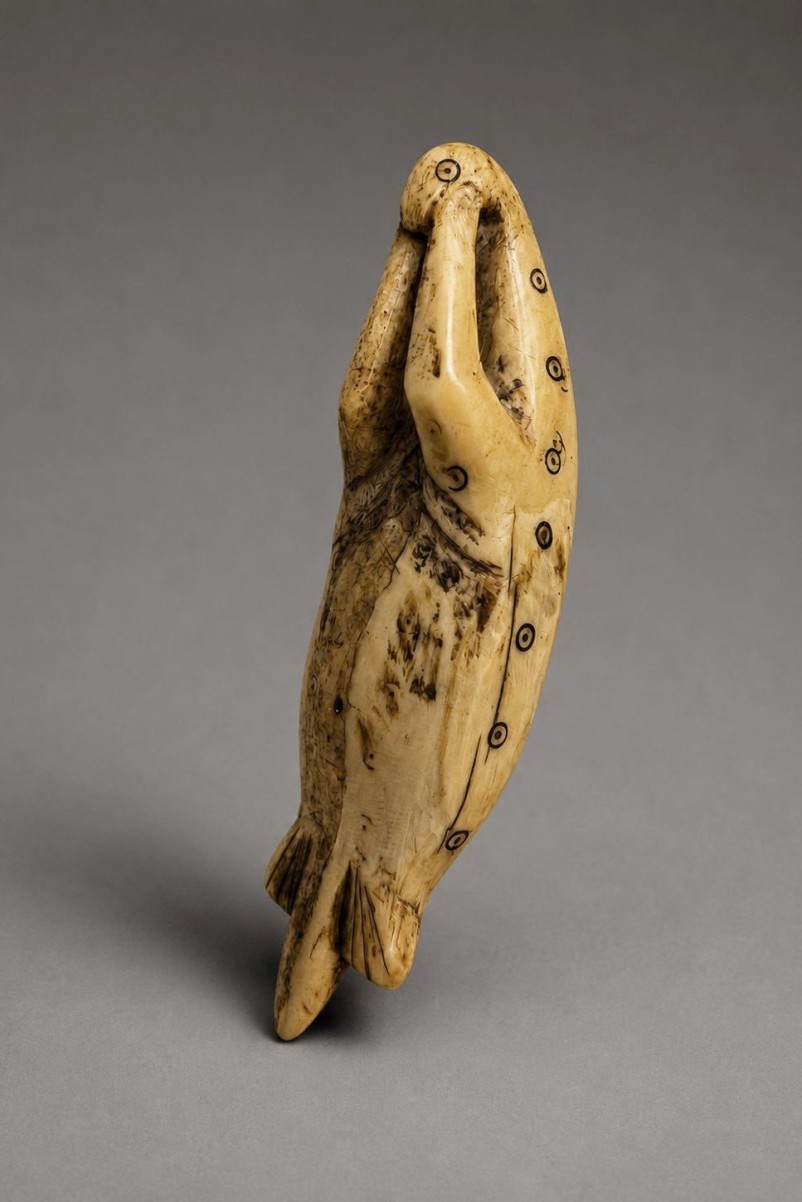
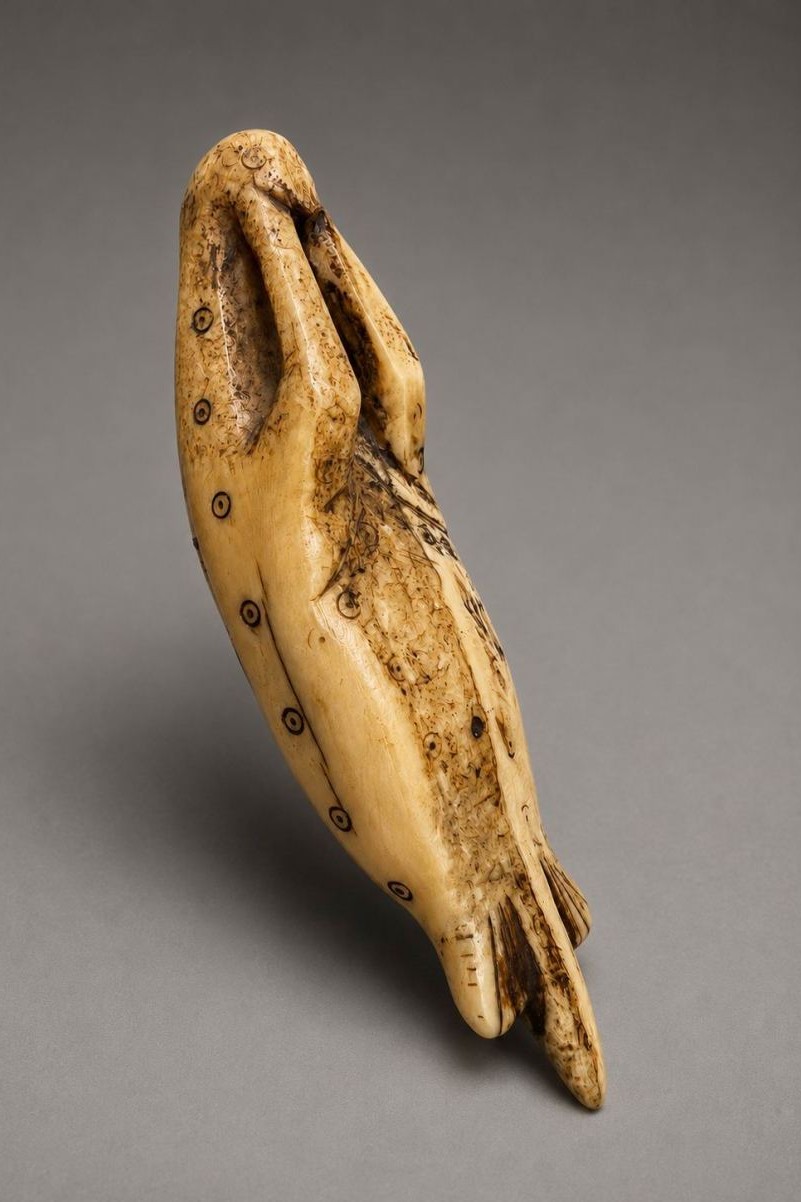
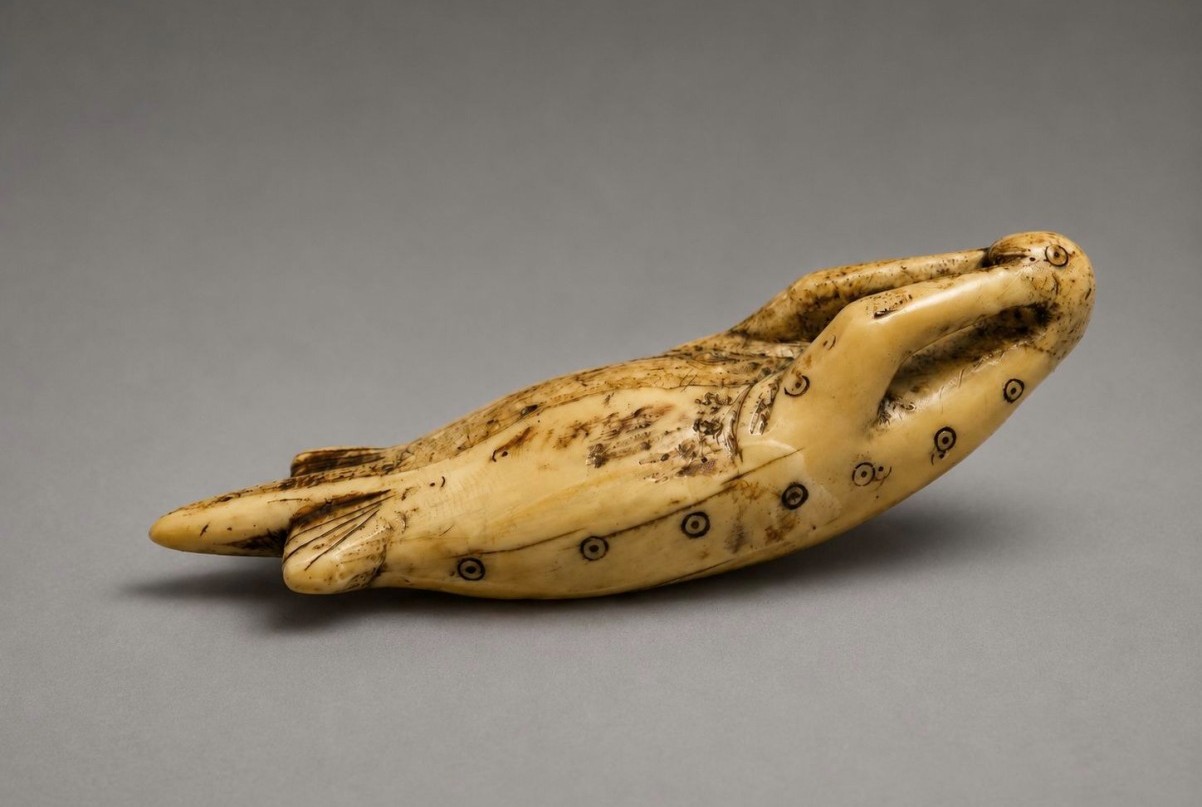
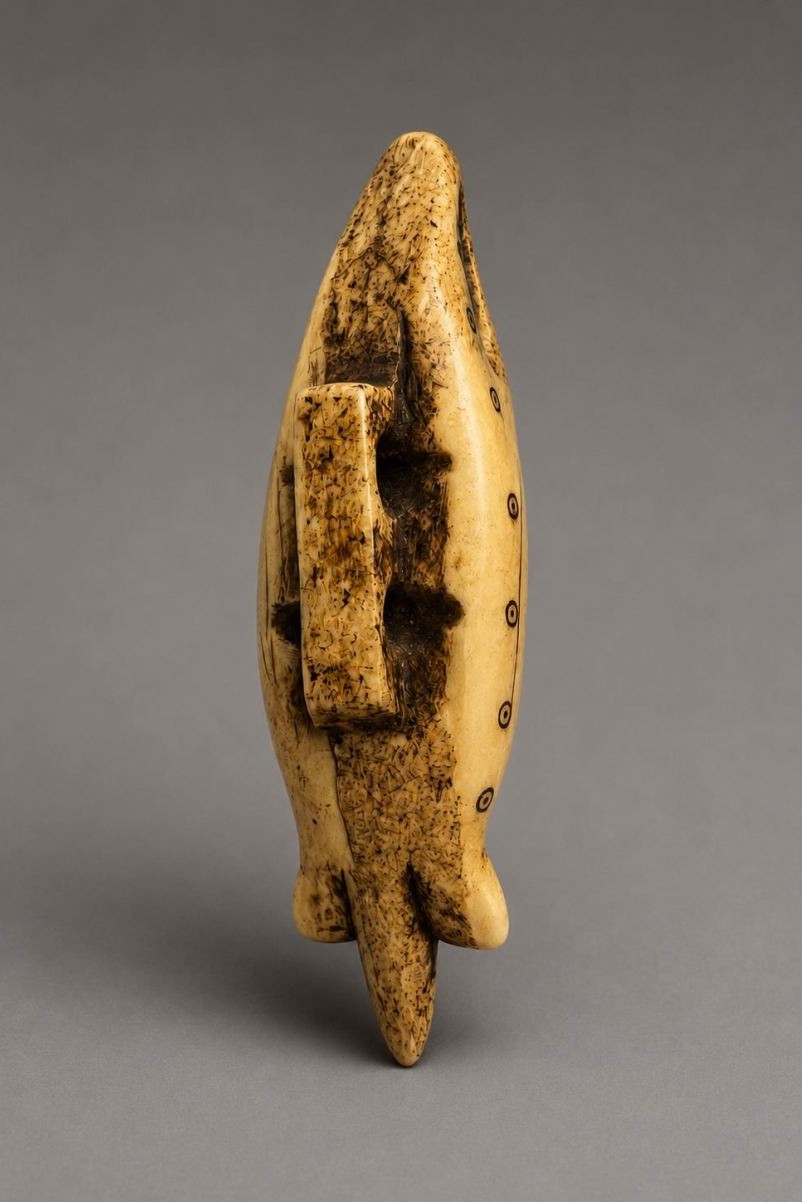
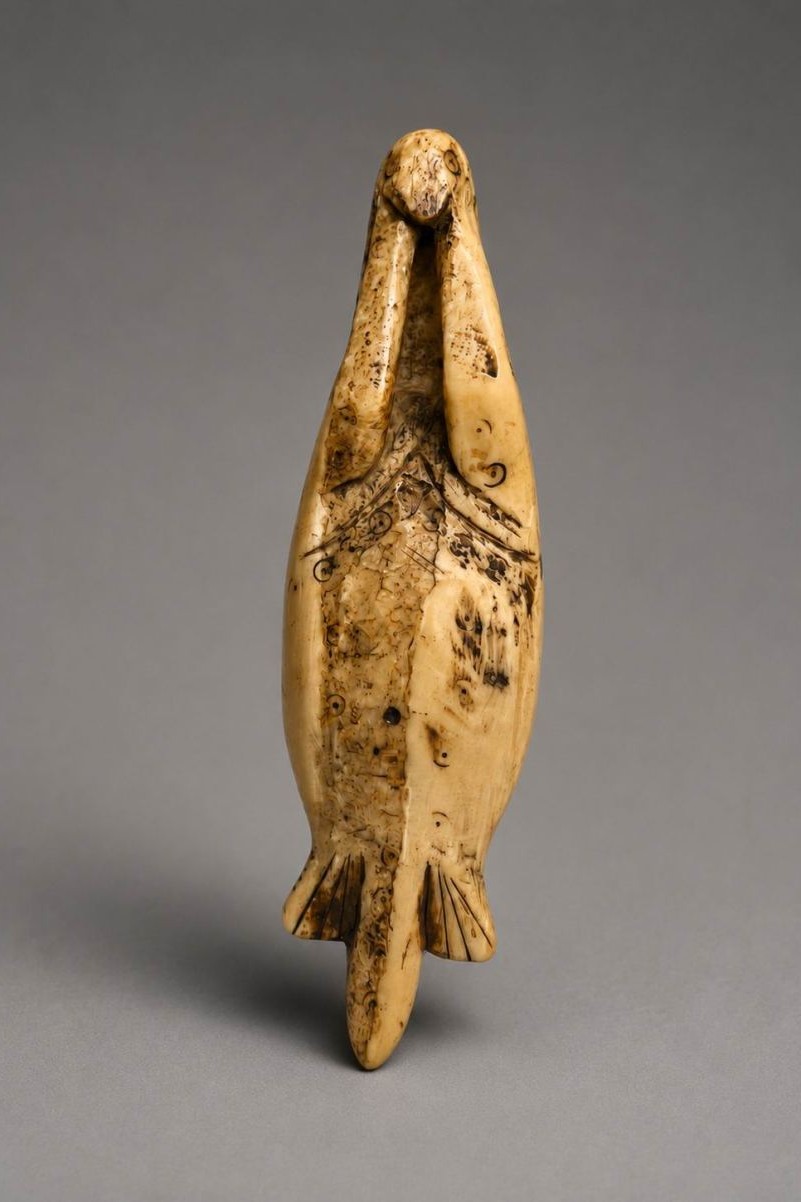
It is rare for a carved object to serve no other purpose than to depict a hunted animal, much like a sculpture. Here is an example: it is a figurine used as a hunting charm.
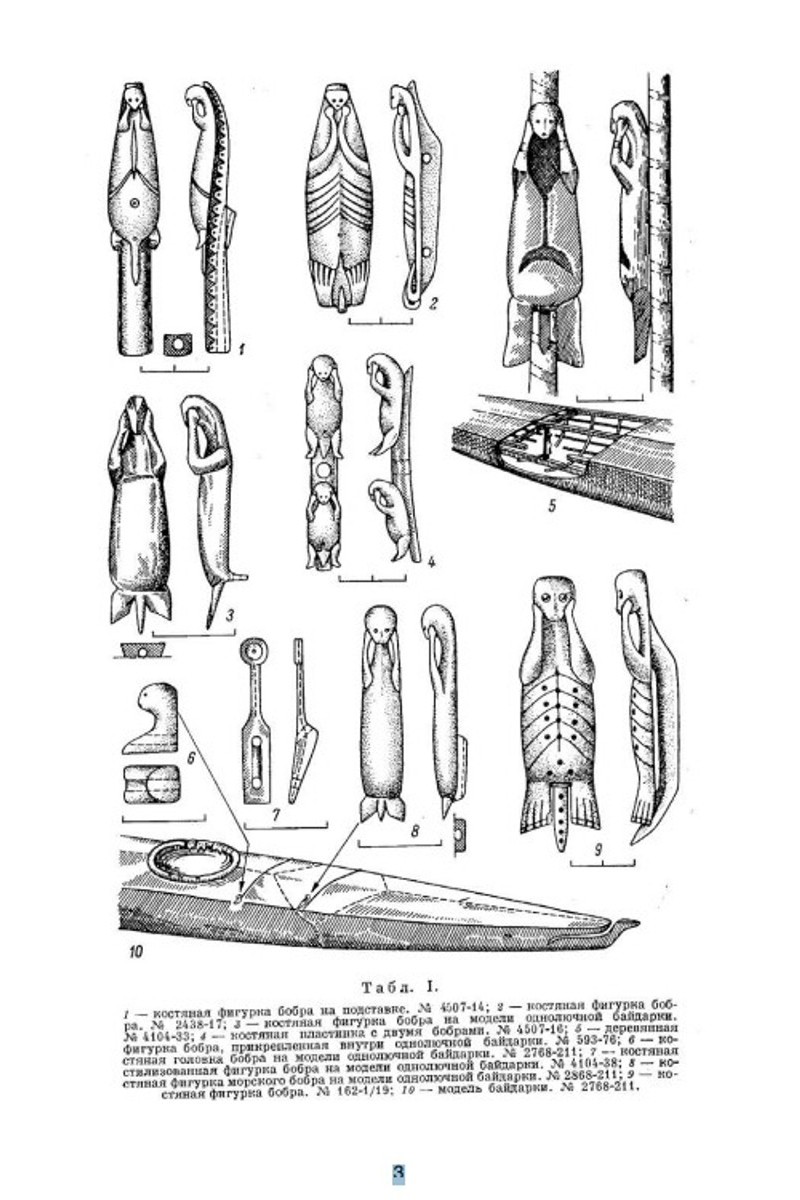
According to Roza G. Liapunova, “Sea otter hunting played a very important role in the Aleut economy. A number of mythological tales were also associated with this animal, and the image of the sea otter appears even more frequently in Aleut sculpture, particularly on the kayak (baidarka)¹—either inside or on the deck, attached to strips of baleen used to hold hunting equipment.” (Liapunova, 1967, p. 42).
This is a communicative figure, depicted swimming on its back with its front paws raised, gently brushing its face, as if it were eating or calling out. This posture appears repeatedly in published Aleut examples and is of particular importance, as imagery of the sea otter appears in both functional and symbolic contexts related to kayak equipment.
1- ” Baidarka ” was the name Russian settlers used to refer to a kayak in the Aleutian Islands.
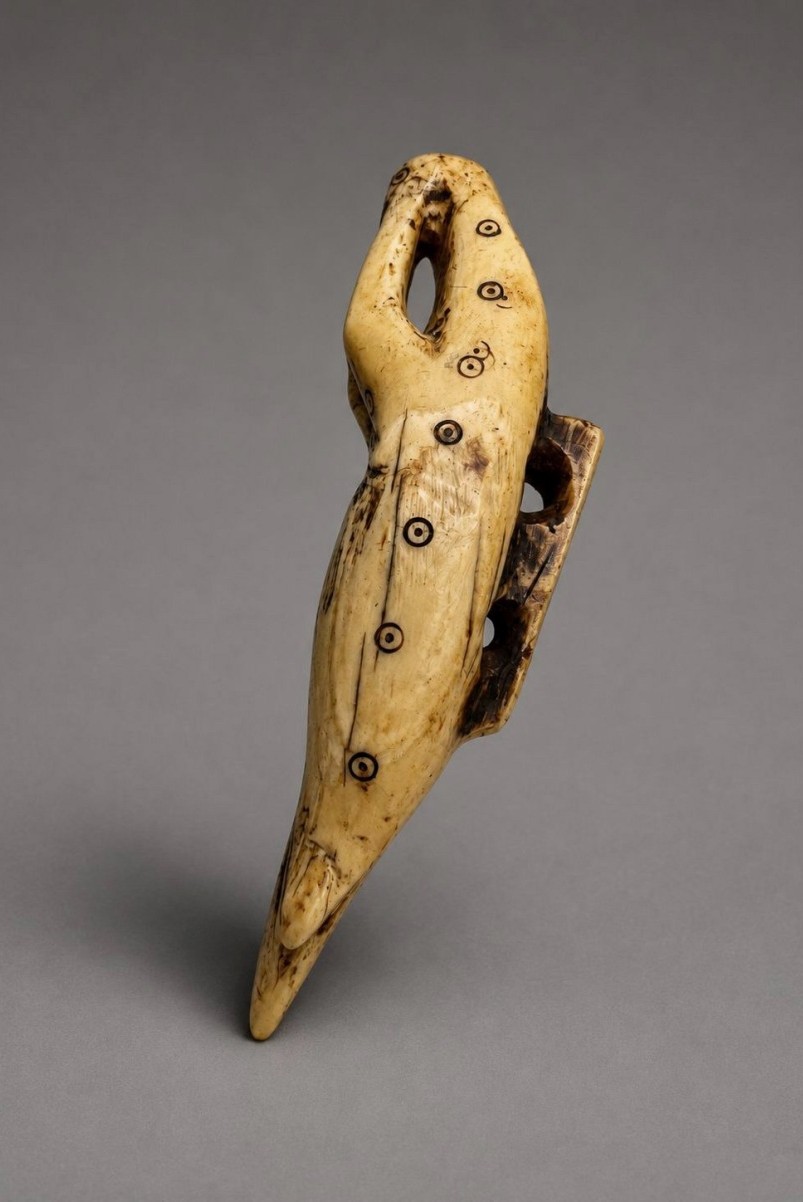
The most significant feature of this object is the suspension structure that has been preserved on the back and side. This feature makes the object much more than a simple zoomorphic ivory sculpture: it visually demonstrates how the figure was part of the baidarka’s fastening system.
The rear structure is not merely decorative: it preserves the mechanical features used to secure or suspend the sea otter figure relative to the kayak’s equipment. Significant wear and patina are evident, concentrated in the recesses.
Among the many examples of such figures preserved in the collections of the MAE (Museum of Anthropology and Ethnography in St. Petersburg) discussed by Liapunova, ours bears a particular resemblance to the 7.5-cm ivory figure purchased in 1881 by I. S. Poliakov at a market in Nagasaki along with a group of netsuke, described as No. 4 in Liapunova, 1967, p. 43, and illustrated in Plate I, Figure 9 (MAE No. 162-1/19). The same plate also shows the positions in which the figurine was attached to and inside the kayak.
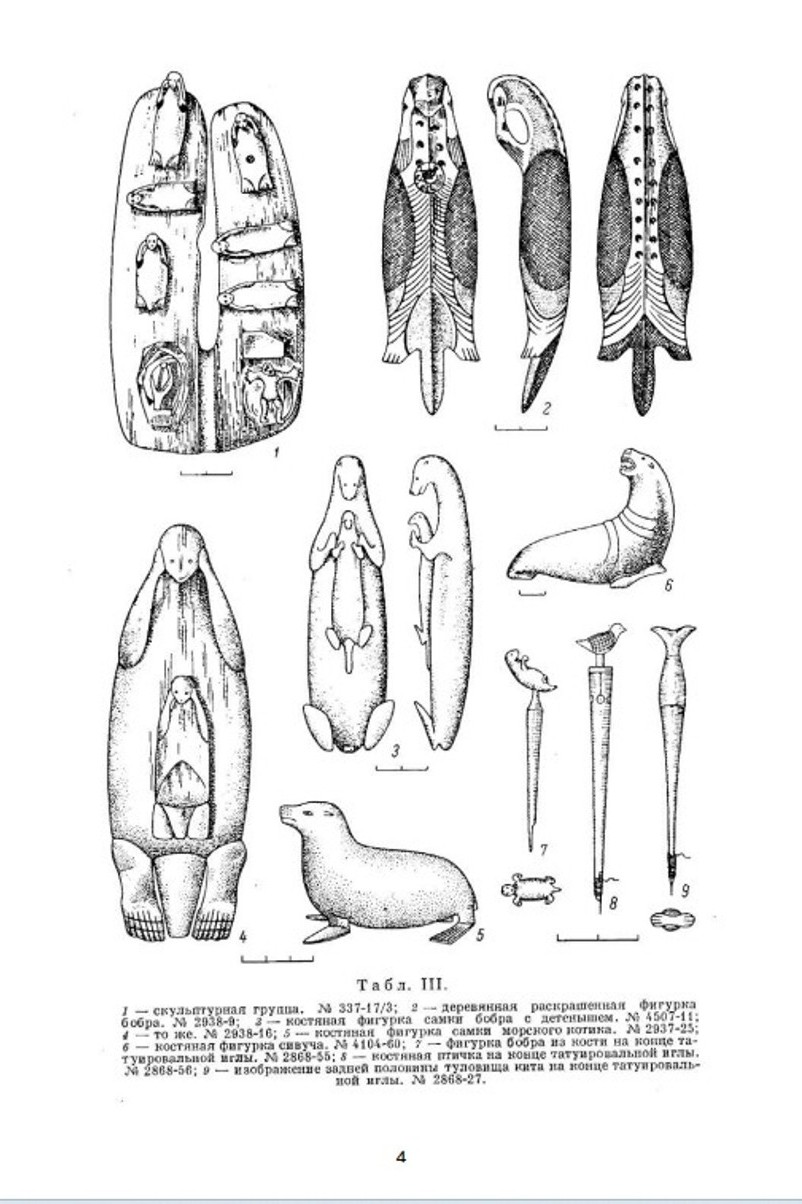
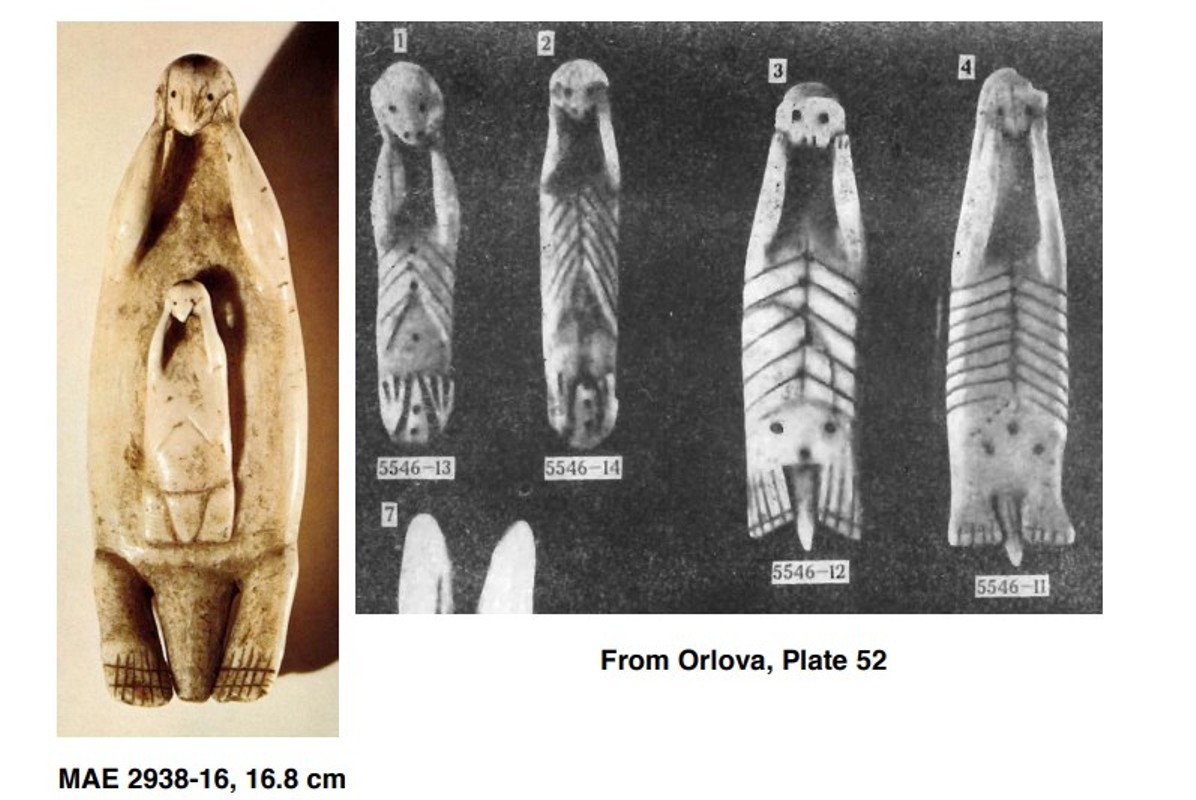
Liapunova also describes “… three sea otter figurines that show no signs of having been attached to or suspended from anything.” These were likely figurines intended for ritual use, or toys, and later possibly intended for trade or sale. These sea otter figurines are depicted in the same manner as those described above, but in a more realistic style and without stylized elements” (Liapunova, p. 44, and Plate III, Figures 2, 3, and 4). They are significantly larger than the figures attached to the kayak, which are made either of ivory (12 and 16.8 cm—see the plate below for the latter) or of painted wood (13.7 cm).
Other Aleut sea otter figurines carved from ivory, likely dating from the early 19th century, are preserved in the collections of the Russian Museum of Ethnography (GME, nos. 5546-11 through 5546-14). They are illustrated in the book by Elizaveta P. Orlova (plate 52, figures 1–4). However, very little reliable information regarding their collection is available.
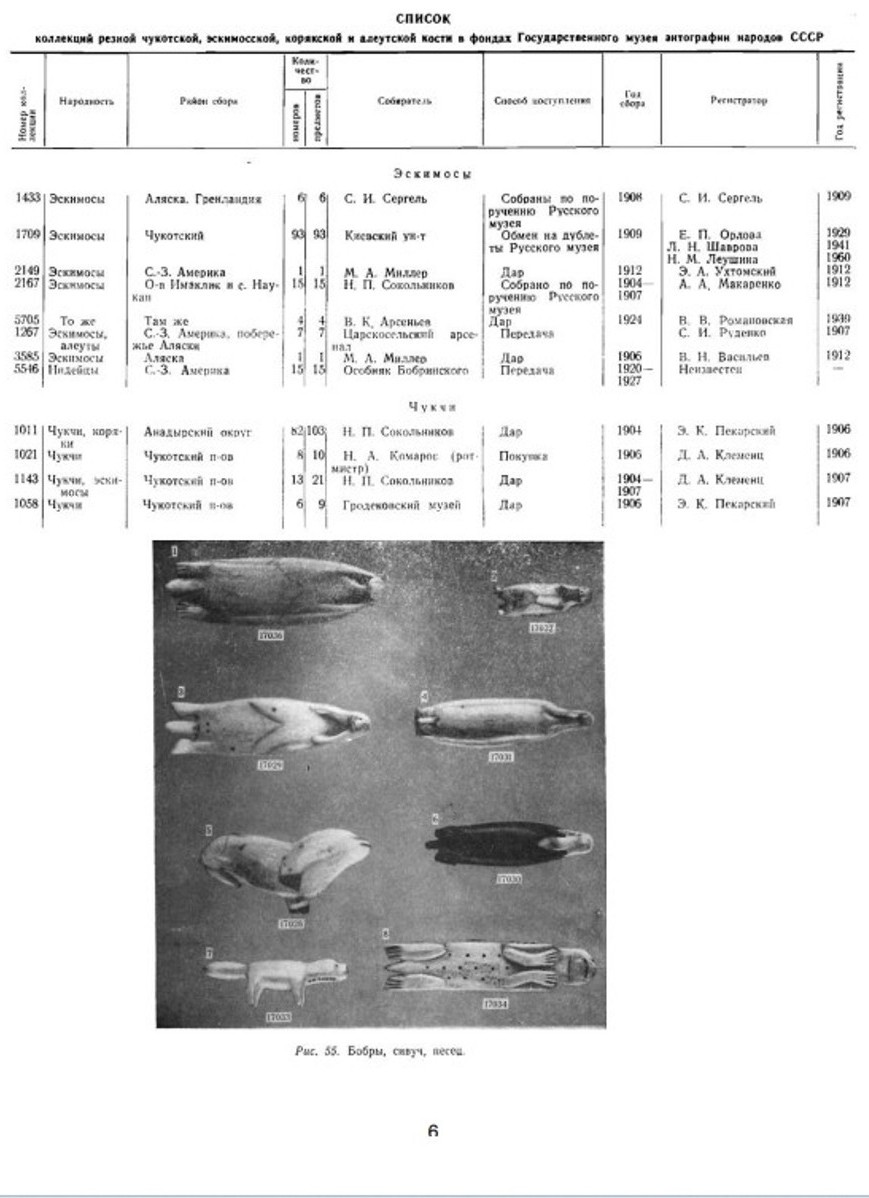
Although correctly identified as Aleut by Elizaveta Orlova, the summary list of the museum’s collections (pp. 36–37) indicates that Collection 5546 comprised 15 objects from “Indians” of the northwestern coast of America, and the “collector” is mentioned only as the “Bobrinsky Palace ” (Saint Petersburg).
The objects were acquired by “transfer” (which was likely, in reality, a confiscation) between 1920 and 1927. The register lists the provenance as “unknown,” and no year of entry into the museum is mentioned.
As head of the ethnographic section of Ryabushinsky’s “Kamchatka Expedition,” Vladimir Jochelson collected a number of ivory whistles and other “toys” carved in the shape of sea otters in the Aleutian Islands between 1909 and 1910. These are also illustrated by Orlova (plate 55), but no specific information regarding their collection is provided in her summary inventory.
Their style and the quality of their carving differ significantly from objects from the early to mid-19th century designed to be attached to kayaks.
Indigenous hunters in the Arctic have described using amulets like this one specifically to help draw animals toward them—which this otter appears to be doing. Here, the circular marks and dots represent the passage through states of transformation; in the shamanic worldview of Alaska’s Indigenous peoples, animals, humans, fish, and birds are seen traveling through concentric circles. Upon crossing a circle, one transforms into another creature in order to adapt to the specific characteristics of the next sphere.
The fact that there are seven pierced points on each side of this otter’s body, and numerous points on its belly, takes on additional significance—perhaps in line with the hunter’s belief that his success depends on the continuous, repeated renewal of his charm throughout his life.
The heavy signs of wear throughout the object indicate that it was used for many, many years.
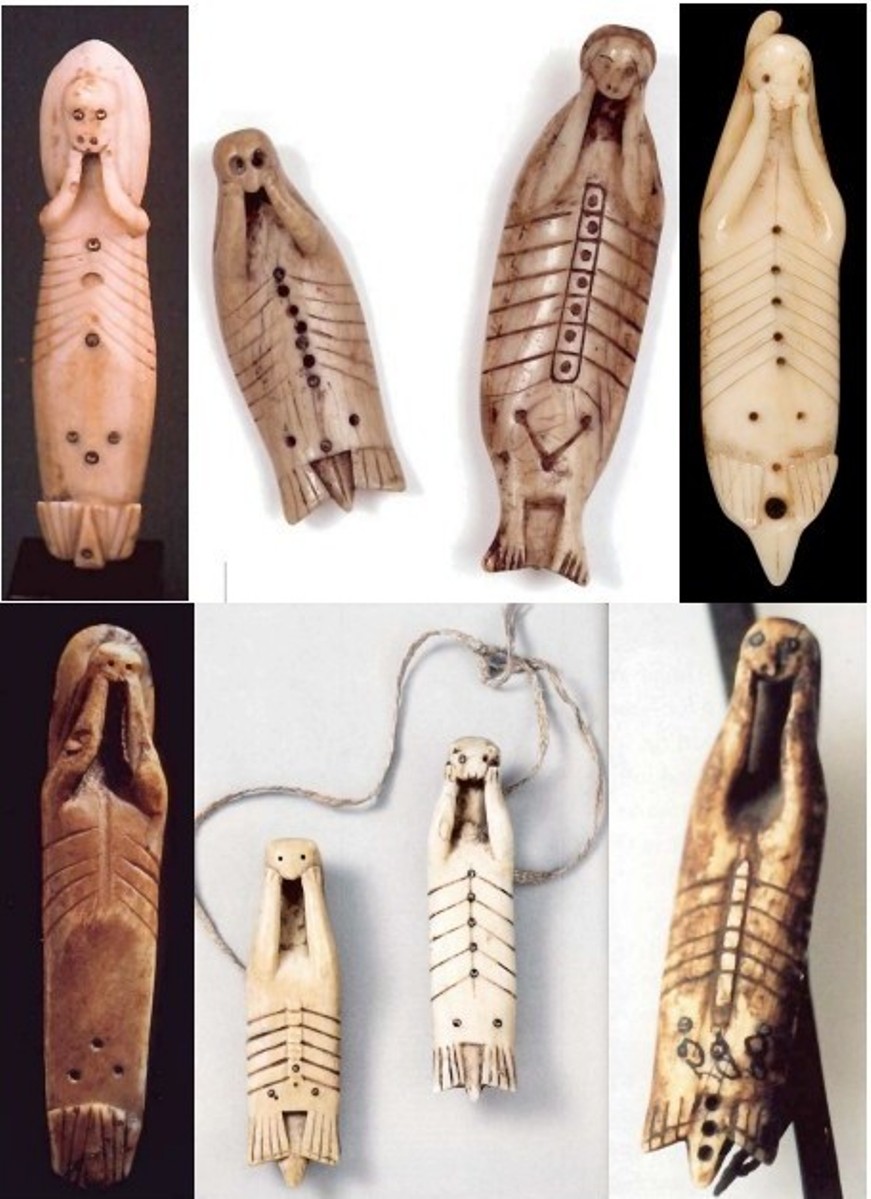
A selection of other Aleut sea otter figurines
(from left to right and top to bottom)
Former James Hooper Collection (8.9 cm);
National Museum of Natural History, Smithsonian Institution, Washington, D.C. (7 and 10 cm);
Musée du Quai Branly, Paris (6.8 cm);
Museo de América, Madrid (7 cm);
Ajaloomuuseum, Tallinn, Estonia (7.6 and 8.3 cm);
Kupreianov Collection, Landesmuseum für Kunst und Kulturgeschichte, Oldenburg.
Bibliography
. Roza G. Liapunova (1967): *Zoomorfnaya skul’ptura aleutov* (“Zoomorphic Sculpture of the Aleuts”), in *Kul’tura i byt narodov Ameriki*, Sbornik MAE, vol. 24, pp. 38–54, plates I and III.
Elizaveta P. Orlova (1899–1976), (1964): *Chukotskaya, Koryakskaya, Eskimoskaya, Aleutskaya reznaya kost’*
(“Chukchi, Koryak, Eskimo, and Aleut Ivory Carvings”), Novosibirsk, Academy of Sciences of the USSR, Siberian Branch.
For further information, please contact us at
(+33)(0) 6 07 23 33 60, or leave us a message:
Galerie Franck Marcelin – 70 chemin du Moulin – 13510 Eguilles – mob: (+33)(0)6 0723 3360 – franckmarcelin@sfr.fr – copyright © 2024